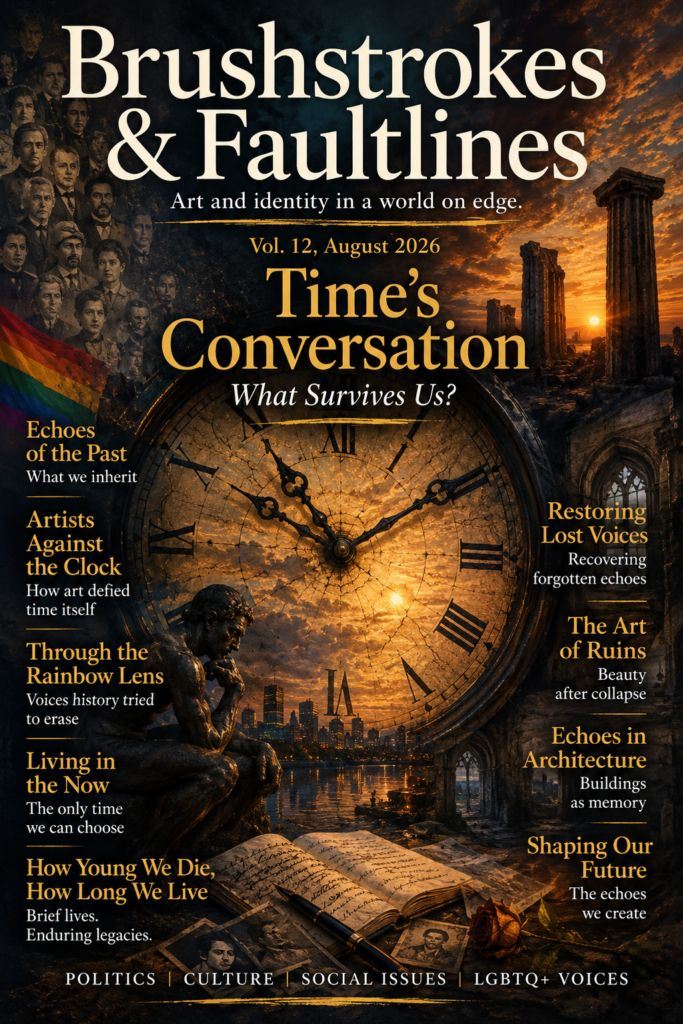
BRUSHSTROKES & FAULTLINES
VOLUME 12 • AUGUST 2026
WHAT SURVIVES US?
Art. Identity. Memory. Legacy.
This month, Brushstrokes & Fault Lines enters a conversation between past, present, and future. Across art, architecture, identity, sacrifice, and remembrance, each contribution considers the same enduring question:
What survives us?
TABLE OF CONTENTS
- LETTER FROM THE EDITOR
Why the Past Still Speaks
An opening reflection on the voices, memories, and unfinished conversations that continue shaping us long after their moment has passed.
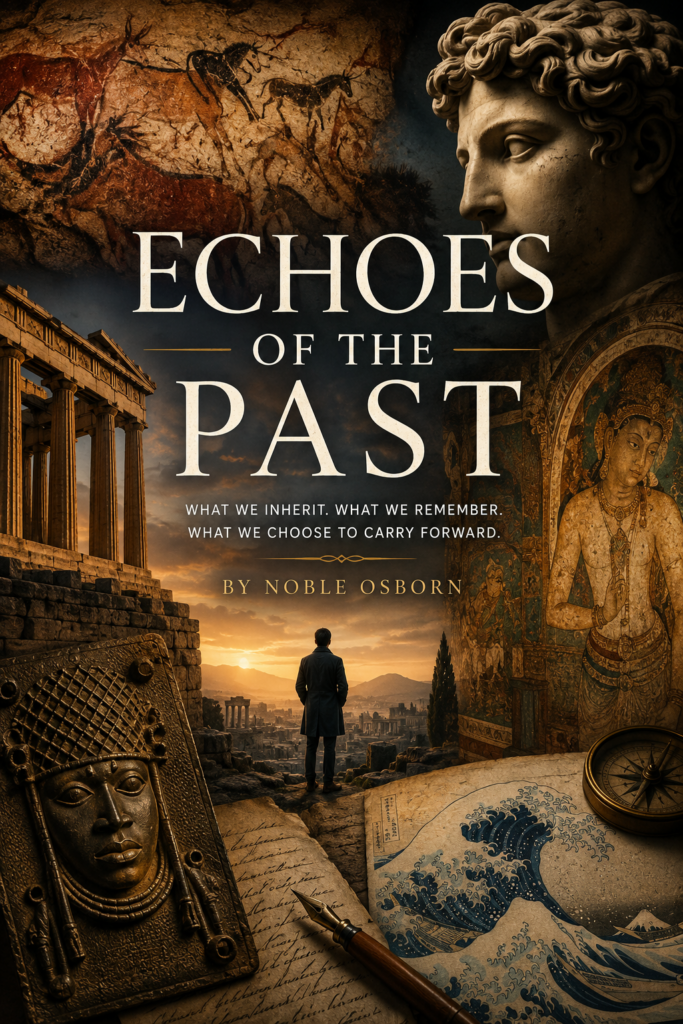
- ECHOES OF THE PAST
What We Inherit
An exploration of the histories, traditions, wounds, stories, and identities handed down to us—and the choices we make about what to carry forward.
- POETIC INTERLUDE I
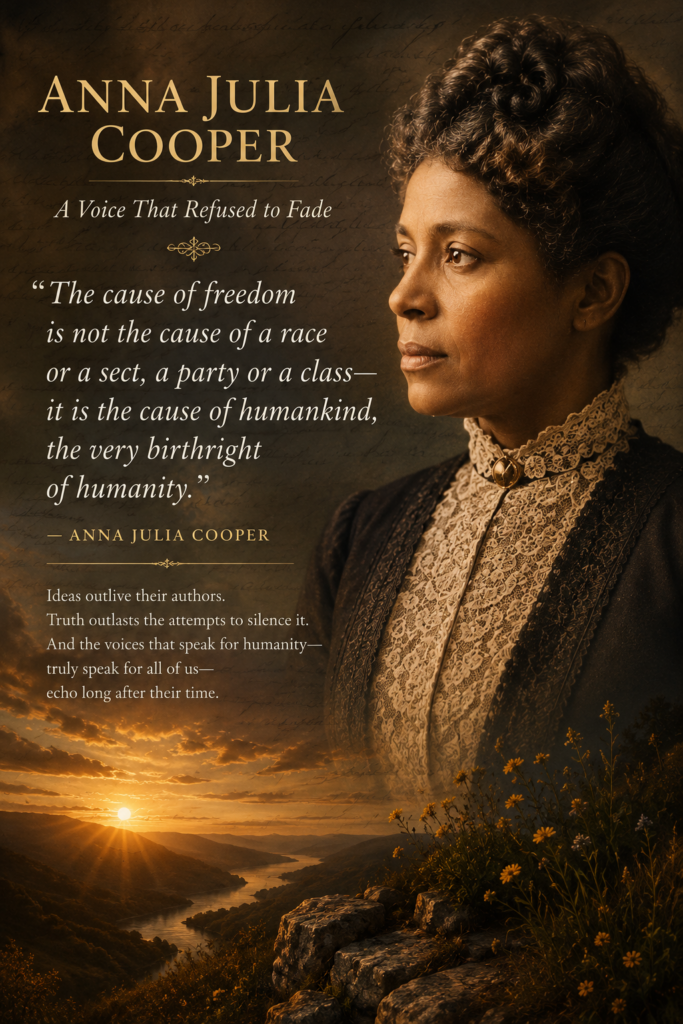
Anna Julia Cooper — The Cause of Freedom
The words of Anna Julia Cooper remind us that the struggle for human dignity belongs not to one race, class, or generation, but to humanity itself.
- ARTISTS AGAINST THE CLOCK
How Artists Challenged Time Itself
From Salvador Dalí’s melting clocks to artists who captured fleeting light, altered chronology, or pursued immortality through their work, this essay examines art’s rebellion against time.
- THROUGH THE RAINBOW LENS
The Echoes They Could Not Silence
Across centuries and cultures, queer artists, writers, and visionaries survived censorship, concealment, persecution, and erasure—leaving voices history could suppress but never entirely silence.
- LIVING IN THE NOW
The Only Place Decisions Can Be Made
The past may explain us and the future may summon us, but the present remains the only place where choices can be made and legacies can begin.
- POETIC INTERLUDE II
T. S. Eliot — Time Present and Time Past
A meditation on the way past, present, and future remain bound together, each moment carrying traces of what came before and possibilities of what may follow.
- HOW YOUNG WE DIE, HOW LONG WE LIVE
Individuals Are Brief. Civilizations Endure.
A reflection on soldiers, sacrifice, national memory, and the troubling contrast between the brevity of an individual life and the longevity of the nations that ask individuals to defend them.
- RESTORING LOST VOICES
Recovering Forgotten Echoes
An examination of the artists, writers, cultures, and histories that nearly disappeared—and the archivists, scholars, descendants, and communities working to return them to the human conversation.
- THE ART OF RUINS
Beauty After Collapse
Why abandoned cities, broken monuments, weathered sculptures, and fractured civilizations continue to fascinate us—and how destruction can become part of an object’s meaning.
- ECHOES IN ARCHITECTURE
Buildings as Memory
From temples and cathedrals to memorials, museums, homes, and public squares, architecture preserves the ambitions, values, conflicts, and absences of those who came before us.
- POETIC INTERLUDE III
Percy Bysshe Shelley — Ozymandias
A ruined monument stands in the desert as a warning against the illusion of permanence—and as proof that poetry may outlive the power it describes.
- SHAPING OUR FUTURE
The Echoes We Intentionally Create
Every generation inherits a world shaped by others. This concluding essay asks what responsibilities accompany that inheritance—and what kind of echo our own choices will leave behind.
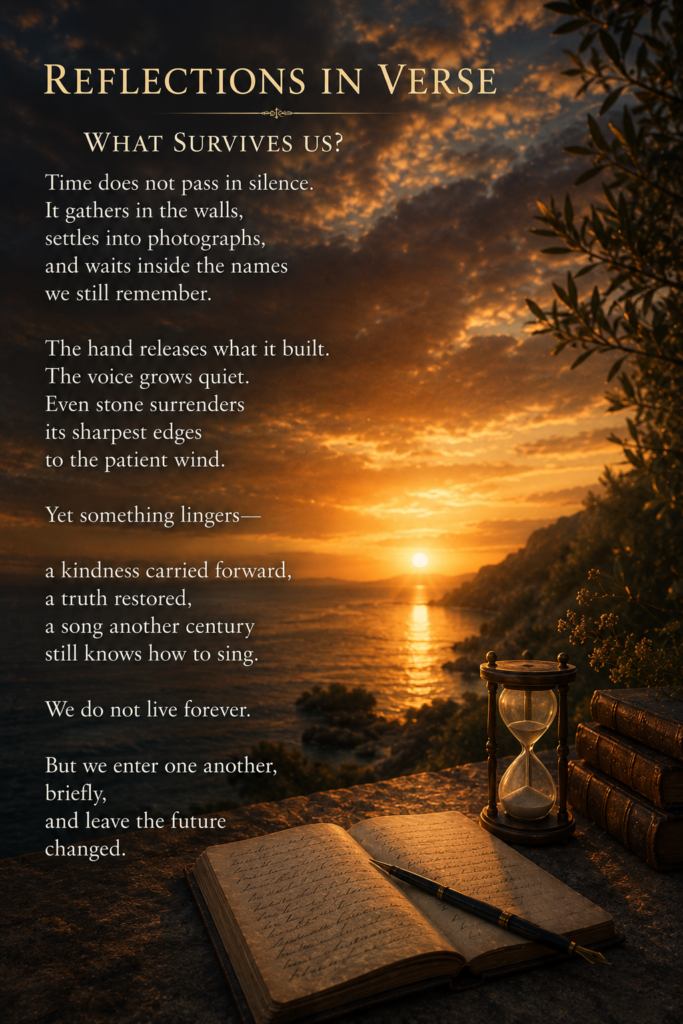
- REFLECTIONS IN VERSE
What Survives Us?
An original closing poem gathering the issue’s central themes into a final meditation on memory, mortality, creation, and the traces we leave in one another.
Letter from the Editor
Why the Past Still Speaks
There hangs in my bedroom a print of Salvador Dalí’s Swans Reflecting Elephants. I have looked at it for years, and like so many of Dalí’s works, it asks to be contemplated rather than merely observed. Recently, while studying its impossible reflections and thinking about Dalí’s lifelong fascination with time, I realized something important.
This issue is not really about time.
It is about our conversation with time.
Dalí’s conversation left behind paintings that will likely be studied centuries after his death. Whether admired, misunderstood, or endlessly interpreted, his voice continues long after his own fell silent. It made me wonder about my conversation with time. If the things I create leave behind ideas that others continue discussing after I am gone, then perhaps I, too, will have contributed something more meaningful than simply shouting into the void.
That realization became the foundation of this issue.
What survives us?
It is an enormous question, one that has occupied philosophers, artists, architects, poets, and ordinary people for as long as civilization has existed. I suspect each of us asks it differently.
I have no children of my own. Someday my nieces and nephews will inherit my belongings. Long before that day arrives, however, I hope they inherit something less tangible. Over the years, I have planted trees that should continue bearing fruit well into the next century. I have tried to care for the land around me, believing that if I leave it a little healthier and more beautiful than I found it, then perhaps some small part of who I was will remain rooted there.
Legacy is not always measured in monuments.
Sometimes it grows quietly from the ground.
As I write these words, I glance toward a set of shelves in the corner of my office. They hold no priceless treasures, yet together they contain the fragments of an entire life. A plush toy from a love long past. A crystal that scatters rainbows whenever the afternoon sun finds it. Photographs of family members, some still with me and others now gone. A silver keepsake box my father gave my mother when I was born. A typewriter from another era, reminding me that every generation believes it is writing the final draft of history, only to discover it has written another chapter instead.
Objects become echoes.
They continue speaking after the hands that placed them there have fallen silent.
Over the past year, Brushstrokes & Fault Lines has wandered through art, politics, architecture, history, identity, conservation, monuments, fathers, and the shifting landscapes of culture. Looking back, I now recognize the thread connecting all of them: the extraordinary passion of the human spirit.
Whether grounded in truth or illusion, compassion or conviction, people pour themselves into what they believe. Our paintings, protests, poems, temples, and mistakes all become expressions of that passion.
Sometimes I wonder whether we have become louder than previous generations or whether modern technology simply amplifies voices that have always existed.
Memory itself refuses to remain still. We preserve photographs, journals, heirlooms, and stories in the hope of freezing a moment forever, but memory softens around the edges. Every familiar story changes slightly in the retelling. Is it because the storyteller has forgotten how it was told before? Or because the memory itself has quietly evolved into something new?
Perhaps memory is less a photograph than a painting, continually receiving another careful brushstroke.
Living in the mountains of northwestern Arizona has also shaped how I think about permanence. Ancient stone has a way of shrinking human ambition into its proper scale. During many August journeys through Colorado, I found myself wandering through Mesa Verde and Canyons of the Ancients, standing quietly among places where entire communities once laughed, argued, celebrated, and mourned.
Their homes remain.
Their names, in many cases, do not.
Places like these remind us how brief our own moment truly is.
Gardening has taught me a similar lesson. A tree planted today may outlive the hands that placed it in the soil. But legacy requires more than survival. Someone must recognize what has been entrusted to them and decide to carry it forward.
Every generation inherits more than property or institutions.
We inherit responsibilities.
Throughout this issue, artists, forgotten voices, soldiers, fallen civilizations, ruins, and buildings all enter the same conversation. Each asks what remains after an individual life has ended and how the living decide which echoes to carry forward.
Among those voices is Anna Julia Cooper, whose words remain as urgent today as when she first wrote them more than a century ago. Long before the vocabulary existed, she understood that a democracy cannot measure its progress only by the freedoms enjoyed by those already closest to power. It must also listen for the people still struggling to be heard.
Civilization, I think, rarely progresses in straight lines.
It advances.
It retreats.
It forgets.
It rediscovers.
It renames.
Perhaps history is less a march forward than an ongoing conversation, each generation responding to voices that came before while unknowingly becoming ancestors themselves.
People often ask why some figures are remembered while others disappear almost immediately. I suspect history tends to preserve either extraordinary brilliance or extraordinary extremism. Quiet lives lived with integrity seldom receive monuments.
Yet perhaps monuments are not the only measure of a meaningful life.
Beauty, after all, often outlives power.
The pyramids still stand.
The pharaohs do not.
The same could be said of the great cities and temples built across civilizations whose rulers are now little more than names in textbooks. Stone survives conquest. Art survives ideology. Hatred can scar generations, but love gives them something worth carrying forward.
I deliberately stepped away from chasing current headlines for this issue. The news will continue tomorrow, next week, and next month. The questions explored here have already survived thousands of years.
They seemed worthy of another conversation.
More than anything else, I hope you slow down while reading these pages. Our lives are astonishingly brief. We do not control how long we are here, but we do influence what we leave behind.
The best we can do is try to become the best people possible during the short time we are given—to stand for what we believe, do what we say we will do, and encourage kindness wherever we find ourselves.
I do not write because I believe I possess answers.
I write because I hope better questions remain with you after the final page.
If someone discovers these essays a century from now, I hope they understand that the loudest voices of our era did not speak for all of us. I hope they find evidence that many of us were trying, however imperfectly, to build something gentler than the world we inherited.
So what survives us?
Not our wealth.
Not our titles.
Not our ambitions.
Rock and sky.
Sand and sea.
The trees we planted.
The songs we sang.
The beauty we created.
The kindness we offered.
Love endures.
Hope endures.
Everything else is simply passing through.
In the fractures, finding light,
Noble Osborn
There is a curious habit we have when speaking about history.
We point behind us.
We speak of “looking back,” as though the past were a country we once visited but have long since left. We imagine it receding farther away with every passing year, fading into dusty archives and forgotten languages, surviving only in museums, monuments, ruins, and stone.
But history has never behaved so politely.
The past has never stayed behind us.
It travels beside us.
Every law we obey, every language we speak, every melody that stirs us, every faith we inherit, every border we cross, every monument we admire, every prejudice we struggle to overcome, and every masterpiece that leaves us speechless is an echo carried forward from lives we never lived.
We awaken each morning believing ourselves thoroughly modern, only to discover that much of what defines us was imagined centuries before we were born.
The present is not merely built upon the past.
The present is inhabited by it.
That realization changes the way we see the world.
When we stand before an ancient sculpture whose marble shoulders have weathered two thousand winters, we are not simply admiring remarkable craftsmanship. We are encountering another civilization’s understanding of beauty. When we read the tragedies of Athens or the sonnets of Renaissance Europe, we hear voices that refused to be silenced by time.
Their languages evolved. Their kingdoms vanished. Their descendants became strangers to one another.
Yet their questions remain startlingly familiar.
What is justice?
What is love?
What do we owe one another?
How should we live?
These are not modern conversations. They are ancient ones, still waiting for every generation to answer them anew.
We like to imagine history as something settled. Dates fixed. Battles concluded. Names engraved. Empires risen and fallen.
But the consequences of history are rarely so obedient.
A dead law can still reach into a living body. An old border can still decide who belongs and who does not. A monument raised generations ago can still determine who feels honored in a public square—and who feels warned.
The past survives not only in artifacts, but in arrangements of power.
It survives in school names, courthouse steps, inherited wealth, family silences, national myths, hymns, holidays, textbooks, flags, and the stories a country chooses to tell about itself. It survives in what we preserve, but also in what we excuse. It survives in what we celebrate, but also in what we refuse to name.
History is not merely behind us.
It is underfoot.
It is overhead.
It is in the room.
Art Remembers
Art remembers better than we do.
Empires collapse. Dynasties dissolve. Armies march into history books and eventually disappear into footnotes. Yet a painted cave wall, a carved temple, a cathedral window, a woven textile, a bronze plaque, a woodblock print, or a weathered manuscript quietly outlives kings who once believed themselves immortal.
Long after governments have rewritten their constitutions, artists continue telling us who people really were.
Perhaps that is why tyrants have always feared artists nearly as much as they have feared historians.
Art preserves not only events, but emotions. It remembers wonder, grief, devotion, rebellion, hope, hunger, vanity, tenderness, and fear with a fidelity that statistics and treaties rarely achieve. A single painting can reveal more about an age than volumes of official proclamations because artists leave behind something governments seldom intend to preserve:
Humanity itself.
At Lascaux, the animals still move.
Across the cave walls of France, painted bodies leap through darkness with an energy that refuses extinction. The hands that made them are gone. The language spoken by those hands is gone. The rituals surrounding the images are gone.
Yet the impulse remains recognizable.
To see.
To mark.
To remember.
To say, in pigment and breath: We were here.
At Ajanta, ancient figures still bend toward one another in color and shadow. Their eyes, gestures, and postures hold devotion across centuries. The cave walls preserve more than religious imagery. They preserve attention—the human desire to make the sacred visible.
In the Benin Bronzes, royal authority, ritual life, political memory, and astonishing technical achievement survive in metal. Their afterlives now tell another story as well: one of conquest, theft, possession, restitution, and return.
Hokusai’s Great Wave, born in nineteenth-century Japan, still rises over the modern imagination with the force of something newly seen. Paracas textiles from ancient Peru prove that memory can survive not only in stone or paper, but in fiber, dye, pattern, and thread.
Art is never merely decoration.
It is time made visible.
It is a civilization’s nervous system preserved in matter.
What We Should Carry
Yet inheritance is not always a blessing.
History has entrusted us with extraordinary achievements, but it has also handed us unfinished arguments.
We inherit music and mythology alongside war and conquest. We inherit breathtaking architecture alongside systems of oppression. We inherit philosophies that expanded human freedom and others that justified denying it. Every civilization leaves behind both masterpieces and mistakes.
The challenge before every generation is not deciding whether history matters.
It is deciding what deserves to be carried forward.
That distinction is essential because remembering the past is not the same as obeying it.
A society can remember a tyrant without honoring him. It can study a monument without preserving its pedestal. It can teach an old law without continuing to enforce its cruelty. It can conserve an artifact while admitting how that artifact was taken, who was silenced, and whose suffering made beauty available to others.
We owe the past memory, not submission.
This is why public memory so often becomes a battlefield.
When monuments are removed, streets renamed, museum collections challenged, or institutions forced to confront the names carved above their doors, the argument is rarely about stone alone.
It is about inheritance.
It is about whether honor should remain where history has become clearer.
A pedestal is not neutral.
A building name is not neutral.
A museum label is not neutral.
Each makes an argument about value. Each tells the public what has been chosen for reverence. To reconsider those choices is not necessarily to erase history. Sometimes it is to stop confusing memory with worship.
The removal of Confederate monuments in American cities, the fall of the Cecil Rhodes statue at the University of Cape Town, the toppling and later museum display of Edward Colston’s statue in Bristol, and the renaming of institutions once dedicated to men whose legacies darkened under closer examination are not signs that history has vanished.
They are signs that history has become active again.
The question is not whether the past should be remembered.
The question is how honestly.
Some echoes deserve amplification. Others deserve exposure. Still others deserve to be studied carefully, not because they are admirable, but because they reveal the architecture of harm.
Inherited damage is not only monumental.
It is also legal, social, and intimate.
Colonial laws once imposed upon bodies, desires, and identities have survived long after the empires that wrote them receded from formal power. Section 377 in India, which criminalized consensual same-sex intimacy until the country’s Supreme Court curtailed its reach in 2018, was one such relic.
Its endurance reminds us that the past does not require a statue to remain dangerous.
Sometimes it sits inside a penal code.
Sometimes it wears the language of morality.
Sometimes it outlives the empire that created it and continues punishing people who had no part in its creation.
This, too, is an echo of the past.
And this, too, must be answered.
Editing Memory
Every generation edits history.
We may not like to admit this. We prefer to imagine preservation as a pure act, as though the past can be handed forward untouched.
But there is no untouched past.
There are only choices made with more or less honesty.
Restoration is editing.
Translation is editing.
Removal is editing.
Renaming is editing.
Curriculum is editing.
Silence is editing.
Even preservation is an editorial act because preserving something means deciding that it should remain available to the future.
To restore a fresco, clean a ceiling, remove overpainting from an altarpiece, or stabilize a ruined wall is to choose which version of an object will continue speaking. Conservation may be disciplined, technical, and reverent, but it is never passive. It requires judgment. It asks what counts as damage, what counts as history, and what future viewers deserve to see.
The restoration of the Sistine Chapel changed the way modern eyes encounter Michelangelo’s colors. The restoration of the Ghent Altarpiece uncovered details hidden beneath later interventions, including the startling face of the Lamb that forced viewers to reconsider what they thought they knew.
These restorations did not create new masterpieces.
They altered our relationship with old ones.
The objects remained.
Our sight changed.
Translation works much the same way.
Every generation hears ancient language through its own moral weather. A translator approaching Homer, scripture, myth, or epic does more than carry words from one language into another. The translator decides what should be clarified, what should remain strange, what violence has been softened by tradition, and what power has been hidden beneath elegance.
A new translation can make an old text feel newly uncomfortable—not because the translator has betrayed the past, but because the past has finally been allowed to speak with fewer disguises.
Museums are also editors of memory.
For centuries, many institutions displayed objects as though beauty had arrived without violence.
A bronze head in a glass case.
A sacred figure on a plinth.
A textile beneath controlled light.
A label describing origin, medium, and date while passing quietly over conquest, looting, excavation, coercion, or removal.
But objects remember the routes by which they arrived.
Restitution, repatriation, and recontextualization are not threats to history. They are part of history’s correction. They ask whether possession is the same as stewardship. They ask who has the right to interpret a wound. They ask whether the future of an object should belong to the institution that acquired it or to the people from whom it was taken.
These questions are uncomfortable because they require us to stop treating the past as a treasure chest and begin treating it as a set of obligations.
Not every inheritance belongs in our hands forever.
Not every echo is ours to keep.
The Quiet Archives
And yet some of history’s most important echoes are not found inside museums at all.
They live around kitchen tables.
In recipes prepared without written instructions.
In songs grandparents still hum.
In family photographs whose names have faded from memory.
In accents carried across oceans.
In weathered letters tied together with ribbon.
In a father’s pocketknife.
In a mother’s favorite chair.
In the smell of cedar, dust, bread, rain, tobacco, perfume, old books, or garden soil.
In customs we continue without ever asking who first imagined them.
Civilization survives because ordinary people quietly become its caretakers.
Every family is an archive.
Every community is a library.
Every life carries fragments of lives that came before.
This is the quieter inheritance—the one less likely to be carved in stone but more likely to shape the daily texture of a human being.
We carry lullabies whose origins we do not know. We repeat phrases once spoken by people long dead. We cook food from homelands we may never have seen. We inherit gestures, superstitions, tempers, faiths, recipes, griefs, and ways of loving that began before us and will continue after us, altered by our use.
History is not only what nations record.
It is what families repeat.
It is what communities protect.
It is what children absorb before they have language for inheritance.
This is why the past can feel familiar even when it belongs to strangers. Its echoes have already become part of us.
To stand before an ancient work of art is to feel that recognition in public. To open an old family box is to feel it in private.
In both cases, we are reminded that the dead are not entirely gone.
They have become architecture, law, melody, pigment, recipe, warning, scar, and seed.
Someone Else’s Past
The temptation of every age is to believe that it stands at the center of history.
We imagine ourselves more enlightened than those who came before and more significant than those who will follow. Yet humility arrives the moment we recognize that future generations will judge us exactly as we now judge our predecessors.
They will ask what we protected.
What we destroyed.
What we ignored.
What we restored.
What we renamed.
What we excused.
What we created.
And what we believed was worth passing on.
The future is already listening.
One day our monuments will weather. Our arguments will seem distant. Our technologies will become quaint. Our certainties will be tested by people not yet born.
They will inherit our beauty and our blindness.
They will walk through the world we made and ask whether we understood the responsibility of becoming someone else’s past.
That may be the true work of memory.
Not nostalgia.
Not worship.
Not endless regret.
Responsibility.
We cannot choose the century that gives us birth. We cannot choose every inheritance placed into our hands. We cannot undo every act of violence, rescue every lost voice, or restore every broken thing.
But we can decide what posture we take toward what remains.
We can preserve beauty without denying brutality.
We can study harm without honoring it.
We can recover voices that were buried.
We can admit that silence was also a choice.
We can refuse to pass forward what should have ended long ago.
And we can create, with intention, echoes worthy of survival.
The future will know us by what we refused to pass on—and by what we took pains to preserve.
The past is already in us.
The question is what, through us, it becomes next.
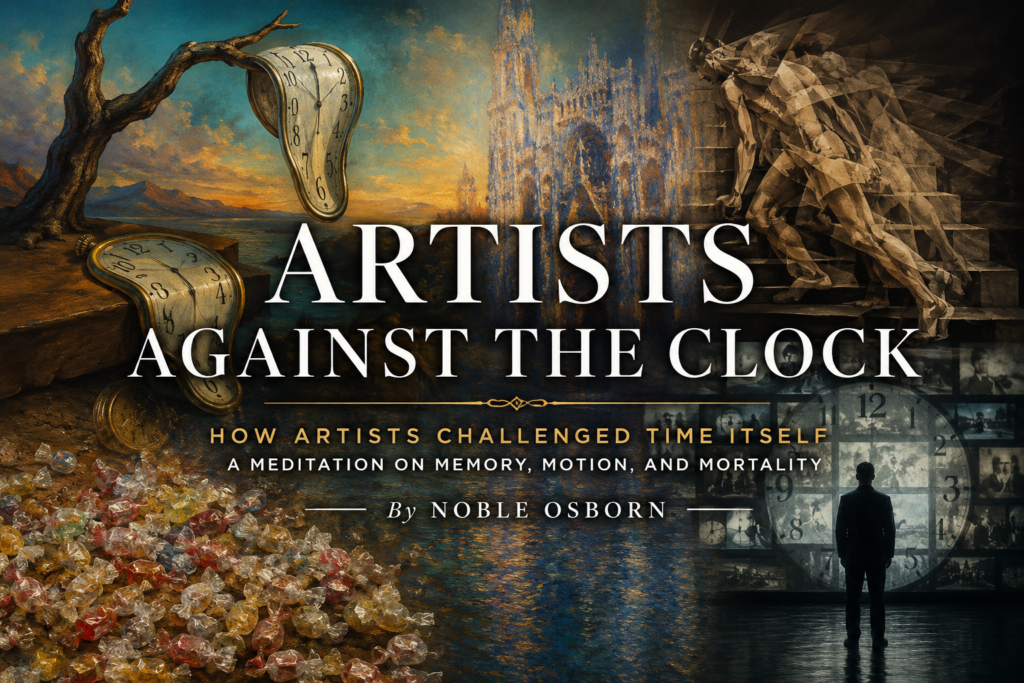
Time is supposed to be the one thing no artist can defeat.
Paint cracks. Bodies age. Cathedrals weather. Empires lose their borders. The hand holding the brush eventually releases it. The studio is swept clean. The century moves on.
And yet, art has always been one of humanity’s most defiant answers to time.
Not because art stops time. It does not. Even the most carefully preserved masterpiece is carried forward by it, altered by context, memory, war, fashion, ownership, restoration, and decay.
What art does is stranger.
It gives time a visible shape.
It allows us to see what ordinarily passes invisibly around us. It turns minutes into symbols, motion into memory, loss into form, and mortality into something that can continue speaking after the living voice is gone.
Certain artists therefore seem less like decorators of their age than challengers standing before the clock.
They do not merely ask what time it is.
They ask what time means.
Salvador Dalí gave modern art one of its most recognizable answers in The Persistence of Memory. The painting is small, almost shockingly so for an image that has grown so large in the cultural imagination. Its landscape is barren and dreamlike. Its clocks are not upright instruments of discipline and order, but limp, melting things draped over branches, ledges, and strange organic forms.
Time, in Dalí’s hands, loses its authority.
It no longer ticks above humanity with mechanical confidence. It droops. It decays. It becomes vulnerable.
The genius of the melting clock is that it does not destroy time.
It humiliates it.
The clock—the proud little machine by which modern life organizes itself—becomes soft as flesh. It can no longer command the day. It cannot discipline the body or divide existence neatly into useful segments. Dalí takes the object most associated with precision and transforms it into something governed by dreams, anxiety, desire, and memory.
That is the first rebellion: insisting that time is not only what the clock says.
Time is also what grief does to an afternoon.
What childhood does to an old room.
What longing does to distance.
What fear does to the seconds before a door opens.
What memory does when it returns without warning.
Dalí was not alone in this rebellion. Modern art, in many ways, emerged from the realization that time could no longer be represented as a single frozen instant.
Marcel Duchamp’s Nude Descending a Staircase (No. 2) did not offer the traditional nude as a stable body arranged for contemplation. It presented the body as sequence, repetition, motion, and descent. The figure is not captured in one elegant pose. It is nearly splintered by its own movement.
The body becomes an event rather than an object.
This was not merely a new way to paint a person. It was a new way to imagine perception. The eye does not experience the world as a camera shutter does. It remembers what came just before. It anticipates what comes next. It overlays one instant upon another until reality becomes layered, unstable, and charged with movement.
Duchamp’s staircase mattered because it turned time into structure.
The figure descends, but the painting refuses to let the descent disappear. Each stage of movement remains present. The past is not erased by the present. It clings to it. It repeats within it. The human body becomes a kind of clock, not because it tells time, but because it reveals time passing through form.
The Futurists also became intoxicated by speed.
Umberto Boccioni’s Unique Forms of Continuity in Space appears to stride out of the old world and into a century of machines, acceleration, engines, war, and industrial force. Its figure is not a person in the ordinary sense. It is movement given muscle. It is the body remade by velocity.
There is something exhilarating in it.
There is also something dangerous.
To worship speed is to forget what speed crushes. Futurism’s love affair with force and momentum became morally inseparable from the violent politics and militarized fantasies surrounding parts of the movement. Yet the artwork still reveals a profound modern anxiety: the sense that humanity had entered a new relationship with time.
The old rhythms of season, village, ritual, and craft were being replaced by acceleration.
The clock was no longer merely on the wall.
It had entered the bloodstream.
Claude Monet approached time differently. He did not melt it, fracture it, or sculpt its speed.
He waited with it.
In his series paintings, particularly those depicting Rouen Cathedral, Monet returned again and again to the same subject under changing conditions of light, weather, and hour. The cathedral remains, but it is never the same. Morning, mist, sunlight, shadow, and atmosphere continually remake it. Stone becomes less permanent than light. Architecture becomes less stable than perception.
This may be one of the quietest and most radical arguments art has ever made about time:
Even permanence changes.
A cathedral is supposed to represent endurance. It is built to outlast generations. It gathers worship, politics, labour, craftsmanship, and memory into stone.
Yet Monet shows that even the enduring thing is never experienced outside time. The hour paints it. The weather edits it. The eye completes it.
Where Dalí makes time surreal, Monet makes it intimate.
He reminds us that we never see the world only once. We see it through morning, age, mood, season, grief, and expectation. The same building seen before and after loss is not the same building. The same garden viewed in childhood and old age is not the same garden. The same nation inherited by different generations is not the same nation.
Time does not merely pass over things.
It changes the meaning of what remains.
By the twentieth century, some artists stopped representing time symbolically and began using time itself as their material.
On Kawara’s Today series, also known as the Date Paintings, began in 1966 and continued for decades. Each painting records the date on which it was made.
Nothing more.
And yet, not nothing.
A date is one of the simplest facts a life can contain. It is also one of the most mysterious. A date can be ordinary to one person and devastating to another. It can mark a birthday, a death, an invasion, a wedding, a diagnosis, or a liberation. It can be a day when nothing seemed to happen until years later, when everything did.
Kawara’s paintings refuse drama, but together they accumulate into something deeply human.
They say: I was here.
Not sentimentally. Not through confession, portraiture, or narrative. Just the date. Just the mark. Just evidence that one day, among all days, a person made something.
There is discipline in that.
There is loneliness, too.
The paintings become less about dates than about survival. To make a date painting is to meet the day directly. To finish one is to leave behind evidence of attention. Against the vast abstraction of history, Kawara offers the small, stubborn fact of presence.
Christian Marclay’s The Clock takes the opposite approach.
Instead of isolating a single day, it floods the viewer with time. The work runs for twenty-four hours and is assembled from thousands of film and television clips involving clocks, watches, appointments, and references to the hour. The scenes are synchronized so that the time shown on screen corresponds to the actual time experienced by the viewer.
It is both an artwork and a functioning clock.
Its brilliance lies in the way it makes viewers feel the absurdity of that function.
Sitting before The Clock, one becomes aware not only of cinematic time, but of one’s own time being spent. You watch actors check the hour while your own hour disappears. You are entertained by time while being consumed by it.
That is both the trap and the revelation.
Marclay turns the gallery into a timepiece and the audience into one of its moving parts. The work is funny, obsessive, hypnotic, and faintly cruel. It reminds us that modern life is saturated with clocks, deadlines, alarms, schedules, countdowns, and appointments, yet none of this control prevents time from passing.
We can measure it perfectly and still lose it completely.
Some artists have challenged time not by measuring it, but by making disappearance part of the work.
Félix González-Torres’s “Untitled” (Portrait of Ross in L.A.) consists of a pile of wrapped candies with an ideal weight of 175 pounds. Visitors may take pieces. The work diminishes. It can also be replenished.
It disappears and returns.
Disappears and returns.
The portrait is not a face, but a body translated into sweetness, weight, sharing, depletion, and renewal.
Few works understand mourning so tenderly.
Here, time is not a melting clock or a cinematic machine. It is the gradual loss of the beloved. It is the public taking away pieces of private grief. It is the body becoming memory, then ritual, then offering.
Replenishing the work does not undo death, but it resists finality. It allows love to reappear in material form, again and again, without pretending that loss has been conquered.
This may be the deepest challenge art makes against time:
Not denial, but return.
A painting cannot make the dead live again. A sculpture cannot restore an empire to innocence. A film cannot return the hour it consumes. A cathedral cannot preserve the exact faith that built it. A pile of candy cannot save the body it remembers.
But art can keep open a conversation that time tries to close.
That is why artists return so obsessively to clocks, ruins, movement, seasons, repetition, bodies, memory, and decay. They understand that everything human is temporary, but they also understand that temporary things can echo.
A brushstroke can carry a century.
A fragment can revive a voice.
A building can preserve the footsteps of the vanished.
A date can become a monument.
A dream clock can become more famous than the machine it mocks.
The artists who challenged time did not defeat it.
They changed the terms of surrender.
They taught us that time is not merely a force that erases. It can also be a collaborator, a weathering hand, a witness, a medium, a wound, and sometimes even a mercy.
Time destroys the body, but it may deepen the work.
It removes the artist, but releases the art into new meanings.
It transforms the present into history, but also allows history to speak again.
The question, then, is not whether art survives unchanged.
Nothing survives unchanged.
The better question is whether art can survive transformation and still matter.
Dalí’s clocks continue to melt because every generation recognizes the fear beneath them. Monet’s cathedral continues to change because we still understand how light alters permanence. Duchamp’s descending figure still moves because modern life has not stopped multiplying the self across moments. Kawara’s dates still accumulate because being alive still means waking into one particular day. Marclay’s clock still runs because we remain both obsessed with and helpless before time. González-Torres’s candies still vanish and return because love, too, survives by changing form.
The clock wins eventually.
Of course it does.
But art makes the clock answer questions it would rather avoid.
What did this hour mean?
Who was here?
What changed while we were looking?
What remains after the body is gone?
And perhaps most urgently:
What will survive us?
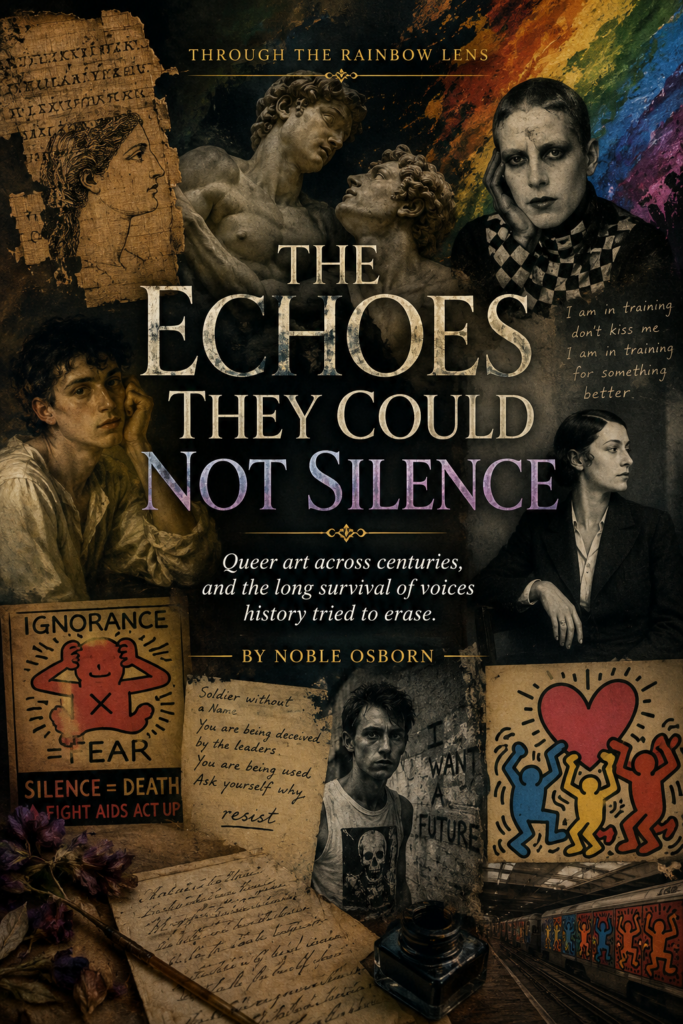
Before there were archives, there were fragments.
Before there were labels, there was longing.
Before history knew what to call certain lives, it already knew how to fear them, edit them, punish them, admire them and, sometimes, preserve them by accident.
Queer history rarely arrives whole.
It comes to us in torn papyrus and altered pronouns, in court records and private letters, in unfinished films, painted faces and coded myths. It survives in photographs that seem to know more about the future than the century that produced them. It hides in museum storerooms, family papers and biographies written carefully enough to conceal the very truths that made their subjects human.
Its absences are often treated as evidence that queer people were not there.
But silence is not the same as absence.
Sometimes silence is manufactured. Sometimes the record was destroyed, the language softened or the scandal made larger than the work. Sometimes the artist was remembered only after being separated from the desire, defiance or identity that shaped the art.
And still, something survived.
Across centuries, queer artists and writers found ways to send themselves forward. Their messages travelled through fragments, bodies, portraits, disguises and flames. Each voice arrived differently, but together they form an archive that has never stopped speaking.
FRAGMENTS
More than 2,500 years ago, Sappho wrote on the island of Lesbos.
Most of her poetry has been lost. What remains reaches us largely in fragments: a complete poem here, several lines there, a phrase preserved because another ancient writer quoted it, or words recovered from papyrus damaged by time.
Yet those fragments were enough.
They carried desire across millennia.
Sappho wrote of beauty, jealousy, memory, absence and the physical disorientation of love. The women in her poetry are not vague symbols placed safely beyond recognition. They are desired, remembered and mourned. Their presence has made Sappho central to queer literary history, even as generations of editors, translators and moralists have tried to explain away what the poems themselves make difficult to deny.
The details of Sappho’s life remain uncertain. Ancient biography is often closer to rumour than record, and applying modern categories too confidently to someone who lived in the seventh or sixth century BCE can create another kind of distortion.
But uncertainty should not become erasure.
We do not need to force Sappho into a contemporary identity to recognize what travelled through her work: a woman speaking with unmistakable intensity about her desire for other women.
What survived was not a complete life. It was not an uncontested biography. It was not even a complete body of work.
What survived was longing.
A broken line can still carry a voice. A missing word can still leave the shape of what was taken. Sometimes a fragment is not evidence of failure.
Sometimes it is evidence that destruction was incomplete.
CODES
Centuries later, Michelangelo filled churches, chapels and public squares with bodies that became nearly inseparable from the story of Western art.
His marble saints and painted prophets were elevated into monuments of genius. His name became safe inside the language of mastery, religion and civilization.
His desires were treated less comfortably.
In 1532, Michelangelo met the young Roman nobleman Tommaso de’ Cavalieri. The artist was nearly forty years older, and the intensity of his attachment survives in poems, letters and a remarkable series of finished drawings made as gifts.
Among them was a depiction of Ganymede, the beautiful youth carried into the heavens by Jupiter in the form of an eagle. Classical mythology gave Renaissance artists a language through which desire could be expressed while remaining protected by antiquity. The myth could be discussed as allegory, beauty, spirituality or intellectual devotion.
It could also say what ordinary language could not safely say.
Whether Michelangelo and Cavalieri ever shared a physical relationship is unknown. What is preserved is Michelangelo’s passion: admiration expressed with an emotional force that later generations found difficult to reconcile with the respectable image they had constructed around him.
The solution was not to destroy Michelangelo’s reputation.
It was to clean it.
When a collection of his poetry was published decades after his death, masculine pronouns were changed in a number of poems so that love directed toward men appeared to have been directed toward women. Words were altered, passages softened and personal desire redirected into safer channels.
The artist survived.
The inconvenient parts of him were edited.
This is one of history’s most effective forms of silence because it leaves the monument standing. Nothing appears to have been destroyed. The paintings remain. The sculptures remain. The famous name remains.
Only the truth has been adjusted.
But language has a memory of its own. Manuscripts survive. Comparisons can be made. Pronouns can be restored. The coded image can be read again.
Michelangelo’s work did not need to be rescued from obscurity. It needed to be rescued from respectability—the kind that preserves greatness by amputating whatever makes greatness difficult.
PUNISHMENT
For other artists, discretion offered far less protection.
Simeon Solomon was born in London in 1840 into a prominent Jewish artistic family. Associated with the Pre-Raphaelites and the Aesthetic movement, he painted biblical scenes, literary subjects, beautiful young men and figures whose identities seem suspended between masculine and feminine.
His work returned repeatedly to desire, secrecy and spiritual yearning. Male beauty was not incidental to it. Same-sex longing moved through his drawings and paintings with a tenderness that could be disguised as mythology or allegory but not entirely concealed.
In 1873, Solomon was arrested for a sexual encounter with another man.
The consequences were devastating.
The fashionable art world that had praised him withdrew. Friends and patrons distanced themselves. His reputation collapsed beneath the weight of the scandal, and the arrest became the central fact through which his life was remembered.
Yet Solomon continued to work.
That continuation matters.
It would be easy to make his story only one of destruction: the gifted artist punished by a society in which love between men was criminalized. But to stop there would allow the punishment to become the final authority over his life.
Solomon’s later work refuses that ending.
More than twenty years after his arrest, he painted The Moon and Sleep, two faces pressed into a dreamlike intimacy. The image does not shout. It does not defend itself. Its beauty is quiet, tender and undefeated.
The world had tried to turn Solomon into a warning.
He kept making art.
His career never fully recovered during his lifetime, but the work remained, waiting for viewers prepared to see more than scandal. Rediscovery could not undo the poverty, rejection or suffering he endured. Restoration is not resurrection. Recognition does not return the years that prejudice took.
But it can refuse the sentence history tried to make permanent.
Solomon’s life reminds us that erasure does not always require destroying an artwork. Sometimes it is enough to destroy the artist’s ability to be seen without shame.
PORTRAITS
By the early twentieth century, queer identity began looking back from the canvas with a new confidence.
Romaine Brooks painted women who did not ask permission to occupy the frame.
Born in Rome to wealthy American parents, Brooks eventually established herself in the artistic and literary circles of Paris. She rejected the brilliant colour associated with many modern painters and developed a restrained palette dominated by black, white, grey and muted earth tones.
The result was not timidity.
It was control.
Her portraits depict women in tailored clothing, severe silhouettes and expressions that resist easy intimacy. They are elegant without performing softness. Androgynous without becoming spectacle. Visible without offering themselves for public explanation.
Some of the women Brooks painted were her lovers. Others belonged to the circles of writers, artists and independent women who gathered around figures such as the poet and salon host Natalie Clifford Barney, with whom Brooks shared a relationship lasting decades.
Brooks did not paint queer life as confession.
She painted it as presence.
That distinction matters. Queer people have often been required to explain themselves before being permitted to exist in public: to supply a childhood, a trauma, a diagnosis, a justification or a declaration. Brooks’s portraits decline that demand.
Her subjects are already there.
They do not emerge from darkness seeking approval. They inhabit their own visual world with the composure of people who understand that the viewer is not the final authority over what they are.
In Brooks’s self-portrait, the artist appears beneath the brim of a dark hat, dressed in black against a subdued landscape. Her expression is difficult to reduce. She appears guarded, assured, remote and entirely conscious of being observed.
The portrait does not ask, “Will you accept me?”
It asks, “What makes you believe your acceptance is required?”
A portrait can outlive gossip. It can outlast the language used to diminish its subject. Long after social circles disappear and private relationships are turned into footnotes, the painted face remains.
It keeps looking back.
MASKS AND RESISTANCE
Claude Cahun understood that identity could be both refuge and rebellion.
Born Lucy Schwob in France in 1894, Cahun adopted a name that resisted easy gender classification. Working closely with lifelong partner and artistic collaborator Marcel Moore, born Suzanne Malherbe, Cahun created self-portraits that dismantled the idea that a face reveals a single, stable truth.
In the photographs, Cahun appears shaved-headed, heavily made up, costumed, mirrored, masked and multiplied. Masculine in one image, feminine in another, theatrical in the next and almost disembodied after that.
These were not simple costumes worn over an authentic self.
The transformations questioned whether there was any single self beneath them.
Long before contemporary language offered broader ways to discuss gender, Cahun’s photographs treated identity as an act of creation. The self could be staged, revised, contradicted and reclaimed. Photography, so often trusted as evidence of what a person truly looked like, became evidence of how little a surface can settle.
But Cahun and Moore’s resistance was not limited to images.
The pair moved to the island of Jersey before the Second World War. When German forces occupied the island in 1940, they began a private campaign against the Nazi regime.
Using information gathered from illegally received radio broadcasts, Cahun and Moore produced anti-Nazi messages in German. They placed them where soldiers might discover them: inside cigarette packets, on tables and in coat pockets. Many were signed as though written by a disillusioned German serviceman—the “Soldier without a Name.”
The strategy was audacious. Two artists, working largely alone, attempted to create the impression of dissent inside the occupying force itself.
Their art had prepared them well.
They understood masks. They understood constructed identities. They understood that a voice could be invented and still speak the truth.
The German authorities eventually arrested them. They were sentenced to death, although the sentences were later commuted, and they remained imprisoned until Jersey’s liberation in 1945.
After the war, Cahun posed for a photograph holding a Nazi badge between their teeth.
The image is small, almost casual, but it contains the conclusion of an argument. The regime that had attempted to control bodies, identities, art and history had been reduced to an object in the mouth of the person it failed to destroy.
Cahun and Moore did not merely survive censorship.
They turned its methods against the censor.
FIRE
By the 1980s, queer artists in the United States were confronting another machinery of silence.
AIDS was killing people while governments delayed, institutions looked away and public language turned illness into accusation. Queer communities were required not only to care for the sick and bury the dead, but also to fight for the right to have those deaths acknowledged.
David Wojnarowicz transformed that abandonment into art.
Working across photography, painting, collage, film, sculpture and writing, he made work that refused the separation of private pain from public policy. His anger was not ornamental. It was evidence.
After the death of his close friend and mentor Peter Hujar from AIDS-related illness in 1987, Wojnarowicz photographed Hujar’s body. The images are intimate without being sentimental. They insist that this death be seen—not as a statistic, a punishment or a moral lesson, but as the death of a particular human being who had been loved.
Wojnarowicz had lived much of his life among people whom respectable society preferred not to see. His art returned that gaze with fury. Maps, clocks, fire, animals, bodies and text collide in work that treats America not as an innocent landscape but as a system capable of deciding whose suffering counts.
He died in 1992 at thirty-seven.
Death did not end the effort to silence him.
In 2010, an excerpt from his unfinished film A Fire in My Belly was removed from the Smithsonian National Portrait Gallery exhibition Hide/Seek after political and religious objections. Nearly two decades after the artist’s death, the institutions presenting queer history were still vulnerable to the same pressures his work had confronted.
The removal proved his argument for him.
Silence was not an ancient custom abandoned by a more enlightened age. It remained an active political choice.
Keith Haring answered the same crisis in a radically different visual language.
Where Wojnarowicz’s work often feels like an exposed nerve, Haring’s figures dance. Babies radiate. Dogs bark. Bodies tumble, embrace and pulse with energy. His thick black lines and simplified symbols travelled through subway stations, murals, posters, clothing, galleries and public campaigns.
The accessibility of the work was part of its politics.
Haring understood that an image placed in public could escape the authority of the museum. It could become familiar before anyone had decided whether it was respectable. It could carry messages about apartheid, addiction, sexuality, AIDS and gay rights into the ordinary visual life of a city.
After being diagnosed with AIDS in 1988, Haring used the time remaining to speak more openly about the epidemic. Works such as Ignorance = Fear and Silence = Death made the stakes explicit. The cheerful visual vocabulary had not become less joyful.
It had become urgent.
Haring died in 1990 at thirty-one. Before his death, he established a foundation intended to support AIDS-related organizations and programs for children.
The artist was brief.
The language survived.
His figures still dance on walls, shirts, posters and bodies around the world. Their repetition has occasionally made them seem detached from the crisis that gave some of them their greatest urgency. But perhaps their survival in public is also a kind of victory.
Haring wanted art to move beyond guarded rooms.
It did.
THE ARCHIVE HAS A PULSE
Sappho survives in fragments.
Michelangelo survives beneath corrected pronouns.
Simeon Solomon survives beyond the scandal intended to define him.
Romaine Brooks survives in faces that do not ask to be explained.
Claude Cahun and Marcel Moore survive in masks, photographs and resistance notes slipped into enemy pockets.
David Wojnarowicz survives in work that institutions still find dangerous.
Keith Haring survives in a visual language carried into the streets.
None of these lives offers a simple story of progress. History does not move cleanly from silence to freedom. A voice recovered in one generation may be threatened again in the next. A museum can restore one artist while removing another. A nation can celebrate queer art from the distant past while legislating against queer people in the present.
Rediscovery is not the end of erasure.
Memory must be defended.
That is why these artists matter together. Their lives crossed different centuries, languages, religions, nations and forms of expression. They would not all have understood themselves through the same words, and we should resist the temptation to make them identical merely because we recognize something shared in their histories.
The connection is not a modern label imposed backward.
It is the recurring struggle to preserve forms of love, beauty and selfhood that power considered inconvenient.
They were fragmented, coded, prosecuted, abandoned, corrected, hidden, censored and mourned.
But they were not silenced.
The people who tried to erase them misunderstood what art can do. A body can be imprisoned. A career can be destroyed. A pronoun can be changed. A film can be pulled from a wall.
But once a voice enters the world, control over its meaning is never complete.
Someone finds the manuscript.
Someone restores the pronoun.
Someone opens the storeroom.
Someone recognizes the face.
Someone presses play again.
The archive has a pulse because someone keeps listening.
What survives us?
Sometimes it is the work.
Sometimes it is the longing inside it.
And sometimes what survives is the very part of us they tried hardest to remove.
Living in the Now
The Only Place Decisions Can Be Made
There is a curious habit of the human imagination: we spend remarkable amounts of time somewhere other than where we are.
We revisit old conversations, replay old mistakes, and polish old triumphs until memory becomes smoother than reality ever was. We imagine futures that inspire us, frighten us, or tempt us into believing that tomorrow will somehow transform us into the people we hope to become.
Between yesterday and tomorrow, we often overlook the only place where our lives are actually unfolding.
The present has never enjoyed the romance of the past or the promise of the future.
History offers the comfort of completion. It has already happened. We can examine it, debate it, reinterpret it, and occasionally misunderstand it, but it will not change simply because we wish it had unfolded differently.
The future, by contrast, remains a blank canvas upon which we project every hope and fear. It is wonderfully generous in that way. It allows us to imagine almost anything.
The present offers no such comfort.
It demands something of us.
Every civilization inherits a story already in progress. None of us begins with an empty page. We inherit languages we did not invent, traditions we did not establish, monuments we did not build, laws we did not write, songs we did not compose, and prejudices we did not create.
We inherit extraordinary works of art alongside extraordinary injustices.
Every generation awakens inside a world assembled by strangers.
Inheritance, however, is not destiny.
The past explains us. It does not excuse us, and it need not imprison us.
This may be one of history’s quietest lessons. Every era believes it is merely reacting to circumstances beyond its control. Only later do historians discover that ordinary people made extraordinary choices in moments that scarcely seemed extraordinary at all.
Revolutions begin with conversations.
Movements begin when individuals refuse to remain silent.
Great works of art begin when someone decides the blank canvas is worth confronting.
No masterpiece has ever been painted yesterday.
No symphony has ever been composed tomorrow.
Creation always happens now.
Artists understand this instinctively. They may draw inspiration from ancient myths or imagine impossible futures, but every brushstroke, every note, and every sentence exists only in the present moment.
Michelangelo could study classical sculpture. Salvador Dalí could melt time across a canvas. Contemporary artists may resurrect forgotten traditions or speculate about worlds not yet born. Yet each ultimately faces the same reality: the work can only be made when the hand begins to move.
Perhaps this is why art survives where certainty does not.
A painting cannot alter the century in which it was created, but it can continue speaking long after its creator has fallen silent. Every generation hears something slightly different because every generation brings new questions.
Great art is not timeless because it exists outside history. It is timeless because it continues participating in history’s conversation.
So do we.
Identity is often described as inheritance. We speak of ancestry, culture, religion, nationality, and family as though they alone determine who we become.
They matter deeply. They give us roots.
But roots are not the same as branches.
Identity is also an accumulation of decisions.
The books we choose to read.
The voices we choose to hear.
The people we choose to love.
The injustices we decide to confront.
The beauty we decide is worth preserving.
The compassion we extend when anger would be easier.
None of these decisions belongs to the past.
None can be postponed indefinitely into the future.
Each belongs to the present.
Our age often encourages us to mistake awareness for action. We possess access to more recorded history than any previous civilization. We can summon centuries of human achievement from a device that fits inside a pocket. Art, music, literature, testimony, and knowledge are available to us in quantities our ancestors could scarcely have imagined.
Yet information alone has never transformed a society.
Action has.
Knowing what should be done has never been the same as doing it.
The present remains stubbornly practical. It asks uncomfortable questions.
Will we preserve this place?
Will we restore this painting?
Will we defend this freedom?
Will we tell this forgotten story?
Will we welcome this stranger?
Will we remain silent?
History records our answers long after we have forgotten giving them.
Perhaps that is why the present feels so fleeting. We rarely recognize its significance while we are living inside it. Only later do we discover that an ordinary afternoon became the beginning of something larger than ourselves.
The conversation that changed a life seemed unremarkable when it happened.
The decision that redirected a nation may have appeared insignificant at the time.
The artist working quietly in obscurity could not know that future generations would one day stand before those canvases searching for meaning.
Legacy rarely announces itself.
It accumulates.
One conversation.
One decision.
One act of courage.
One refusal to surrender.
One kindness offered without expectation of recognition.
When we speak of the future, we often imagine monuments, institutions, or works of art that will outlive us. Yet the most enduring echoes are not always the grandest.
A teacher inspires a student who later changes a community.
A parent teaches compassion that quietly passes through generations.
An artist encourages another artist.
A single voice refuses to disappear despite every attempt to silence it.
Civilizations are built in moments too small for history books to notice.
Only later do those moments become history.
That realization should not burden us.
It should liberate us.
We cannot rewrite yesterday.
We cannot inhabit tomorrow.
But today remains astonishingly unfinished.
Its pages are still blank enough to accept another sentence.
Its canvas still welcomes another brushstroke.
Its melody still waits for another note.
The past will always speak, and it deserves to be heard. Memory offers wisdom, perspective, and humility. The future will always call us forward, reminding us that our work is never complete.
But neither the past nor the future can make a single decision.
Only the living can do that.
Only those who inhabit this brief and fragile present possess the remarkable privilege of choosing what kind of echo they will leave behind.
Perhaps that is why the present matters so much.
It is not merely where we happen to live.
It is where history becomes memory.
It is where hope becomes reality.
It is where inheritance becomes legacy.
It is the only place where the future is still listening.
How Young We Die, How Long We Live
Individuals Are Brief. Civilizations Endure.
By Noble Osborn
A nation can survive a war. A soldier cannot survive being killed in one.
That is the cruel arithmetic at the heart of every civilization that asks the young to defend its oldest promises. Countries speak in centuries. Soldiers die in years. Empires imagine themselves eternal. Families remember the particular sound of a voice that no anthem can restore.
There is something almost supernatural in the way nations describe themselves. They are born, they rise, they fall, they endure. They are motherlands, fatherlands, homelands, promised lands. They are said to possess souls, destinies, memories, wounds, and dreams. Their borders are defended as though they were skin. Their flags are treated almost as bodies. Their monuments are built from stone because stone offers the illusion that memory can be made permanent if only it is heavy enough.
But nations do not breathe.
They do not bleed.
They do not sit at kitchen tables waiting for letters that never arrive. They do not leave empty chairs at holidays. They do not reach for a child’s photograph and realize that the child in the frame has become older than the person was ever permitted to be.
Only people do that.
And yet people are the substance from which nations are made. Every border has been walked by human feet. Every flag has been raised by human hands. Every law has passed through human mouths. Every road, temple, courthouse, bridge, battlefield, and memorial was touched by someone whose name may now be gone.
Civilizations survive by borrowing the lives of the living and later calling the arrangement history.
This is not always cruelty. Sometimes it is how belonging is created. There is dignity in service, beauty in devotion, and courage in standing for something larger than oneself. A nation, at its best, can become the shared shelter of millions who will never meet and yet agree to live beneath a common promise. It can hold language, memory, art, ritual, law, landscape, grief, and hope together long enough for one generation to leave something more than hunger and fear to the next.
But that promise becomes dangerous when it forgets the size of the lives being asked to carry it.
A country can say, “We must endure.”
A commander can say, “The line must hold.”
A politician can say, “History will remember.”
But history is a poor substitute for living.
The young know this, although they are often the least permitted to say it. They are sent forward at the very age when life has only begun to declare itself. They may be old enough to die for a nation, yet too young to have fully known the nation they are dying for. They may not yet have bought a home, raised a child, watched their own face change in the mirror, forgiven a parent, buried a friend, learned the private geography of a lasting love, or discovered the quieter self that arrives after youth’s first performance has ended.
When a soldier dies young, a country does not merely lose a body.
It loses an unfolding.
It loses the person who existed and the person still becoming. The letters unwritten. The children unborn. The jokes untold. The arguments never resolved. The ordinary afternoons that should have been wasted and, because they were ordinary, treasured. The work that might have been done. The kindness that might have been offered. The mistakes that might have been survived. The old age that might have been earned.
Death in war is often described in clean language because clean language makes unbearable things easier to place inside public ceremonies.
The fallen.
The brave.
The honoured dead.
The cost of freedom.
The price of peace.
There is truth in some of those phrases. There is danger in them as well.
Ceremony has a necessary purpose. It gives grief a shape when grief is otherwise formless. It tells families that the dead were not discarded. It gathers a community around loss and insists that the private ache belongs, in some measure, to everyone. A name engraved in stone is not nothing. A folded flag is not nothing. A bugle call at dusk is not nothing. These rituals matter because without them nations might become even more careless with the people they have consumed.
But ceremony can also smooth the edges of horror.
It can make the dead easier to admire than to mourn. It can turn fear into valour, confusion into destiny, and politics into inevitability. It can place flowers over questions that still deserve answers. It can transform a young person’s interrupted life into a symbol so polished that no fingerprints remain.
That is one of civilization’s oldest habits: using the dead as evidence that the living must continue.
Ancient cities did it. Empires did it. Kingdoms did it. Republics do it. Modern states perform the ritual with better cameras and louder sound systems, but the transaction remains much the same. Young bodies are carried into the machinery of national survival, and later the nation returns with marble, brass, speeches, and days of remembrance.
The monument says they will never be forgotten.
But who, exactly, are “they”?
The soldiers as people, or the soldiers as proof?
It is one thing to remember the dead. It is another to recruit them into a story they can no longer refuse.
Every nation has its preferred memory of war. Some remember triumph. Some remember martyrdom. Some remember liberation. Some remember betrayal. Some remember only what confirms their nobility. Others remember so much pain that suffering itself becomes part of the national character.
Even the most honest remembrance struggles against the same temptation: to make the sacrifice feel completed.
A memorial invites us to believe that the debt has been paid because the name has been preserved.
But a name is not a life.
A name is the smallest surviving fragment.
There is a silence surrounding military death that public language rarely enters. Not because the deaths are hidden, but because they are often made visible in the wrong way. We see the uniform. We see the flag. We see the grave marker. We hear the anthem. We are taught to stand.
We are not always taught to imagine the person outside the frame.
What music did they love?
Who annoyed them?
What did they want for breakfast?
What frightened them that they never admitted?
Who was the last person they thought about?
What version of themselves had they not yet become?
A nation cannot answer these questions. Families can. Friends can. Lovers can. Children sometimes can, although only through stories told many years later.
The nation remembers in categories.
The heart remembers in fragments.
And still the nation endures.
That is the unsettling truth. Countries survive losses that would destroy a household. A family may be rearranged forever by a single death, while the state absorbs thousands and continues printing stamps, collecting taxes, holding elections, paving roads, arguing about budgets, and celebrating anniversaries.
The machinery moves.
The anthem plays again.
New children are born beneath the same flag. New soldiers are trained. New speeches are written. New wars are explained as necessary.
Civilizations have a way of outliving their children.
This does not mean civilization is meaningless. It means civilization becomes morally dangerous when treated as more real than the people within it.
A nation is an agreement. A powerful agreement, certainly. A beloved agreement, sometimes. An agreement worth defending, perhaps.
But it remains an agreement.
It exists because human beings consent, inherit, obey, resist, imagine, and maintain it. It is not a god. It is not a parent. It is not eternal by right. It is a structure built from human trust, and trust can be betrayed.
The dead force a question upon the living:
Was this worthy of them?
Not simply: Did they die bravely?
Bravery is often present because human beings are capable of astonishing courage even inside circumstances in which they should never have been placed.
The harder question is whether the cause was worthy. Whether the leaders were honest. Whether the danger was necessary. Whether the promises made afterward were kept. Whether the nation that survived became more just, more careful, more humble, and more protective of the lives still entrusted to it.
A country that asks people to die for its future owes them more than remembrance.
It owes them a future worthy of the loss.
This is where the conversation becomes uncomfortable, as it should. Nations prefer gratitude to accountability. Gratitude is easier. It requires bowed heads, solemn music, wreaths, and words such as honour.
Accountability requires memory with teeth.
It asks not only that we praise sacrifice, but that we examine the conditions that demanded it.
Who benefits when the young are sent to die?
Who decides what is necessary?
Who is expected to carry the cost?
Who is memorialized, and who disappears?
Who returns home wounded to a society eager to celebrate service but reluctant to bear its consequences?
The dead are not the only people a nation owes.
It also owes those who return altered.
Those who survive war do not always return to peace. Some carry the battlefield in the body. Some carry it in the nerves. Some carry it into marriages, employment, sleep, silence, anger, addiction, isolation, or rooms where no one knows how to ask the right question.
They, too, are part of the bargain between individual life and national endurance.
A civilization cannot claim to honour sacrifice if it abandons those who survive it. Nor can it claim innocence when it wraps suffering in symbols and then refuses to look beneath them.
Still, there is something profoundly human in the desire to belong to a story longer than oneself. That desire should not be mocked. People have crossed seas, defended villages, protected neighbours, resisted tyranny, and endured impossible hardship because they believed the future could be guarded by present courage.
Many of the freedoms we inherit were not given gently by time. They were held open by people who paid dearly.
The question is not whether sacrifice can be noble.
Of course it can.
The question is whether nations are noble enough for the sacrifices they request.
That question extends beyond war. Civilizations are built by the brief lives of individuals who rarely live long enough to see the full result of their labour. The mason who shapes a cathedral stone does not hear every prayer that will one day rise beneath its ceiling. The farmer who plants an orchard may not taste its finest fruit. The artist may die poor before the museum learns their name. The activist may be buried before the law changes. The soldier may fall before the peace treaty is signed.
The future is always inheriting gifts from people who could not remain to open them.
That is why legacy is never simple.
We speak of what survives us as though survival itself were proof of value. But terrible things survive. Hatred survives. Borders drawn in violence survive. Lies survive. Systems endure long after the people harmed by them are gone.
Ruins survive.
Myths survive.
Songs survive.
Names survive in stone even when the full lives behind those names have vanished.
Survival is not the same as goodness.
A civilization can endure and remain unworthy. A nation can grow old without growing wise. A flag can continue to fly above failures it has never confessed.
Longevity is not absolution.
And yet the human longing for endurance remains. We want something to outlast us. A child. A poem. A garden. A house. A country. A cause. A work of art. A memory placed in someone else’s keeping.
We know our lives are brief, so we reach instinctively toward continuance.
Perhaps this is why nations possess such emotional power. They offer ordinary people a share in something that appears larger than death. But the size of that promise is exactly why it must be handled with reverence and suspicion.
When a nation says, “Die for me,” the living must ask why.
When a nation says, “Remember them,” the living must ask how.
When a nation says, “We endure,” the living must ask what kind of endurance is being preserved.
There is no single answer large enough to resolve the paradox. We need nations, but we must never confuse them with the lives that compose them. We need memory, but we must never allow memory to become propaganda. We need ceremony, but we must never allow ceremony to replace grief. We need courage, but we must never let courage excuse the failures of power.
Perhaps the best a civilization can do is become more careful with the young.
More careful with their bodies.
More careful with their futures.
More careful with the stories it tells after they are gone.
The dead ask nothing of us because the dead cannot ask. That is why the responsibility belongs entirely to the living.
We are the ones who remain inside the nation they left behind. We inherit the roads, the laws, the freedoms, the debts, the myths, and the unfinished arguments. We decide whether their memory becomes merely a monument or also a warning.
A warning against vanity.
A warning against easy glory.
A warning against leaders who speak of sacrifice while standing far from danger.
A warning against any country that loves its symbols more than its citizens.
What survives us?
For some, a name in stone.
For some, a photograph.
For some, a medal in a drawer.
For some, only the ache carried by those who loved them.
For nations, the answer is more complicated. They survive through stories, borders, songs, buildings, languages, ceremonies, laws, and the stubborn belief that tomorrow must still belong to someone. They survive because the living keep choosing—or are compelled—to maintain them.
But when a country survives longer than the people who died for it, survival alone is not enough.
It must become worthy of them.
It must build a future that does not treat their absence as the cost of doing business. It must remember them not as decorations for national pride, but as human beings whose lives were larger than the manner of their deaths. It must hold their youth against its own age and feel, if not shame, then at least humility.
A nation may speak in centuries.
A soldier dies in years.
Between those two truths lies the burden of civilization: to ensure that what lives long does not become careless with what lives briefly.
The country may endure.
The monument may endure.
The anthem may endure.
The grave marker may endure.
But the person does not.
And that should make us very careful about the things we ask people to die for.
The past is not silent.
It is shelved. Sealed. Misfiled. Misnamed. Mistranslated. Sometimes it is left in a house no one thinks to enter, folded into boxes and stacked beneath dust, waiting for weather, accident, curiosity, or mercy.
We like to imagine that history remembers what matters. We are taught to believe that greatness announces itself so loudly that it cannot be ignored. A masterpiece survives because it is a masterpiece. A symphony endures because it deserves to be heard. A voice remains because something within it is too powerful to vanish.
History has never worked that cleanly.
The archive is not neutral. The canon is not an untouched mountain range waiting to be mapped. Museums, libraries, conservatories, publishing houses, universities, critics, collectors, churches, courts, families, and governments have all acted as gatekeepers between the living and the remembered.
Some opened doors.
Many closed them.
Behind those doors were names that should have been spoken more often, works that should have been performed, paintings that should have been seen, books that should have remained in print, and voices that should never have required rescue.
For an issue asking what survives us, the restoration of lost voices may be one of the most necessary conversations. The answer is not simply that art survives, memory survives, or genius survives. Survival often depends upon who is permitted to be remembered. It depends upon who possesses the institutional power to declare that something matters. Sometimes it depends upon whether one person, years later, notices a silence where a voice should have been.
Sometimes survival begins in the most fragile way imaginable:
With paper.
Florence Price knew something about the burden of creating beauty in a world that was not built to hear her.
Born in Little Rock, Arkansas, in 1887, Price became one of the most important American composers of the twentieth century. She wrote symphonies, concertos, chamber music, songs, piano works, and arrangements that brought European classical traditions into conversation with the spiritual, folk, and cultural language of Black America.
In 1933, the Chicago Symphony Orchestra performed her Symphony in E minor, making her the first African American woman to have a symphonic work performed by a major American orchestra.
That should have been enough to secure her place in history.
It was not.
Price composed within a country that often treated Black brilliance as an exception rather than an inheritance, and female ambition as an intrusion rather than an authority. She wrote for a musical world that could celebrate European male composers as universal while treating Black women as curiosities, novelties, or footnotes.
Her music carried history, but the institutions around her did not always know how—or did not always wish—to listen.
After her death in 1953, much of her work slipped from public view. It did not disappear all at once. That is rarely how forgetting happens.
Forgetting arrives through neglect.
A score goes unpublished. A performance does not happen. A critic does not write. A university does not teach. A conductor does not program. A publisher does not invest. One generation grows up without hearing the name, and the next assumes that the silence means there was nothing there.
Then, decades later, manuscripts connected to Price were discovered in a house that had fallen into disrepair.
There is something almost too symbolic in that image: music waiting inside a damaged house. Not lost because it lacked value. Not silent because it had nothing to say. Silent because no one had carried it forward with the care it deserved.
That discovery did more than recover compositions. It unsettled the story American music had been telling about itself.
Once Florence Price returns, the question changes. It is no longer enough to ask why she disappeared. We must ask what kind of musical culture allowed itself to continue without her. What did concert halls become accustomed to not hearing? What did audiences mistake for absence? What did students inherit as “the tradition” when so many voices had been left outside its locked rooms?
Restoration, in this sense, is not nostalgia. It is not a sentimental act of dusting off old things simply because old things are beautiful.
It is correction.
It is confrontation.
It is a refusal to let institutional neglect masquerade as historical judgment.
Florence Price is not alone.
Artemisia Gentileschi painted during the seventeenth century with a force that should have made her impossible to diminish. Her canvases are not timid. They do not ask permission to enter the room. They arrive with muscle, shadow, blood, intelligence, and psychological power.
Her women are not decorative figures arranged around male heroism. They think. They resist. They act.
They look back.
For centuries, however, Artemisia’s reputation was often trapped inside the facts of her biography. The rape she endured as a young woman, the trial that followed, and the violence surrounding her early life became the frame through which her art was too often interpreted.
The woman was not forgotten exactly, but she was narrowed. She was remembered as a victim before she was honoured as a painter. Her trauma became more legible to history than her mastery.
This, too, is a form of erasure.
Not all lost voices disappear completely. Some remain visible but distorted. They are known, but for the wrong reasons. They are included, but conditionally. They are discussed, but always through a wound. Their work is treated as evidence of suffering rather than evidence of genius.
Artemisia does not need pity.
She needs to be seen clearly.
To stand before her paintings is to encounter an artist who understood power from the inside out, who commanded composition, light, gesture, drama, and human consequence. Her work does not survive merely because it fits modern narratives of female endurance, though it certainly speaks to them.
It survives because it is great.
It makes the viewer uncomfortable in ways that lesser art cannot. It refuses to let beauty become passive.
When Artemisia is restored to the centre of Baroque painting, the entire room changes. Caravaggio still matters, but he no longer stands alone in the dramatic darkness. The story grows wider. The light falls differently.
The canon cannot simply add one woman and proceed as before.
It must admit that it was incomplete.
Hilma af Klint asks an even stranger question:
What if history’s timeline was wrong?
For much of the twentieth century, the story of abstraction was told through familiar male names: Kandinsky, Mondrian, Malevich. The movement toward pure form, colour, geometry, and spiritual intensity was narrated as though it possessed a clear sequence, a proper genealogy, and an approved line of fathers.
Then Hilma af Klint returned.
Her work is vast, luminous, symbolic, strange, and difficult to categorize. Spirals, circles, diagrams, botanical forms, geometric arrangements, spiritual systems, radiant colours—her paintings seem less like objects than transmissions.
They do not behave like polite entries in the history of modernism. They feel like messages from a future that arrived too early.
For years, af Klint remained at the margins of the story. Her interest in spiritualism and theosophy made her easy to dismiss in an art world that knew how to romanticize male mysticism while treating women’s visionary systems as eccentricity. Her abstractions predated and complicated the timeline museums and textbooks had already made comfortable.
The consequence of her re-emergence has been profound because she does not merely add another name to the history of abstraction.
She changes its beginning.
That is what lost voices do when they are truly restored. They do not behave. They do not quietly take an assigned seat at the edge of history.
They rearrange the furniture.
They ask why the room was built this way in the first place.
Hilma af Klint’s return reminds us that the past is not fixed simply because it has already happened. Our understanding of it can still be transformed. A painting created more than a century ago can arrive late and still alter the present. A body of work hidden from public recognition can force scholars, curators, and viewers to reconsider what they thought they knew.
The past does not change.
The story does.
Literature has its own ghosts, and few American examples are more powerful than Zora Neale Hurston.
Hurston was not a minor figure waiting politely to be discovered. She was a central voice of the Harlem Renaissance: an anthropologist, novelist, folklorist, dramatist, and one of the great gatherers of Black Southern speech and culture.
Her writing carried rhythm, wit, sensuality, intelligence, and fierce independence. She listened to people whom other writers flattened into symbols. She allowed Black life to be intimate, comic, sacred, contradictory, and self-possessed.
And still, by the time of her death in 1960, Hurston had fallen into poverty and relative obscurity. Her grave went unmarked. Her work did not occupy the place it should have held.
Then Alice Walker went looking.
That act matters.
Not because one writer created another’s greatness—Hurston’s greatness was already there—but because Walker modelled a form of literary daughterhood, a willingness to search the ground for a woman the culture had allowed to sink beneath it.
She did not treat the absence as natural.
She treated it as a wound.
There is something deeply moving about one artist reaching backward toward another. It suggests that legacy is not only vertical, passed down through official institutions, awards, curricula, and monuments.
Sometimes legacy is recovered sideways.
Through affinity.
Through recognition.
Through one voice hearing another across time and saying:
You should not be alone there.
Hurston’s return changed American literature. It changed how readers understood the Harlem Renaissance. It changed how Black women’s writing was taught, published, and claimed. It expanded the possibilities available to later writers who needed ancestors not merely of blood or nationality, but of language, courage, and form.
This is the quiet power of restoration.
It gives the living a larger past.
When lost voices return, they do not only receive justice for themselves. They return parts of our inheritance to us. They make the present less lonely. They remind artists working now that they did not begin from nothing.
Someone before them also wrote against dismissal.
Composed against prejudice.
Painted against confinement.
Sang into locked rooms.
Carried beauty through systems that had made no room for their names.
Restoration, however, is complicated.
We should be careful with the romance of rediscovery. The word can flatter the discoverer more than the artist. It can turn neglect into adventure. It can make the recovery of a forgotten figure resemble a treasure hunt rather than an indictment.
We must ask who is doing the restoring, who benefits from it, who controls the newly valuable archive, who profits when a once-neglected artist becomes fashionable, and whether the restored voice is being heard clearly or merely used to decorate the conscience of the present.
There is danger in turning lost artists into moral accessories.
A museum can celebrate a forgotten woman while continuing to underrepresent living women. A concert hall can program Florence Price once and call it correction. A publisher can reissue a neglected writer while ignoring the conditions that continue to silence others. A culture can enjoy the drama of recovery without dismantling the habits that made recovery necessary.
Restoration must be more than applause after silence.
It must become sustained attention.
A restored voice needs performances, not anniversaries alone. It needs scholarship, but not only scholarship. It needs classrooms, translations, recordings, exhibitions, editions, criticism, public access, and living engagement.
It needs to be allowed complexity.
It must be freed from the burden of representing everyone who shared the artist’s race, gender, sexuality, nationality, or exclusion. It needs room to be great, flawed, difficult, unfashionable, contradictory, and alive.
That may be the highest form of restoration: not turning the forgotten into saints, but returning them to full humanity.
The canon has often preferred its outsiders simplified.
The woman painter becomes a survivor.
The Black composer becomes a symbol of perseverance.
The queer poet becomes a fragment of longing.
The mystical abstractionist becomes an eccentric.
The rediscovered novelist becomes a lesson in neglect.
Each label may contain truth, but none is large enough to hold a life.
To restore a voice is to let it exceed the reason we first returned to it.
Artemisia is more than her trauma.
Florence Price is more than her exclusion.
Hilma af Klint is more than a correction to Kandinsky.
Zora Neale Hurston is more than a rediscovery story.
They are not merely evidence against the past.
They are creators of worlds.
Perhaps that is why their return feels so urgent now. We live in a time obsessed with memory and yet surrounded by forgetting. Digital culture preserves almost everything and absorbs almost nothing. Names trend and vanish. Images circulate without context. Outrage performs remembrance for a day. Algorithms create their own unstable archives, pushing some voices forward while burying others beneath the endless now.
In such a world, restoring lost voices requires more than finding them.
It requires slowing down long enough to listen.
Listening is different from recovery. Recovery locates the object. Listening allows it to speak.
A manuscript can be found and still not be heard. A painting can be exhibited and still not be understood. A writer can be reprinted and still be misread. A composer can be programmed and still be treated as an obligation rather than an encounter.
To listen is to allow the returned voice to make demands of us.
Florence Price asks us what American music sounds like when its Black women are no longer treated as exceptions.
Artemisia Gentileschi asks us what art history looks like when women’s power is not reduced to their pain.
Hilma af Klint asks us what modernism becomes when its spiritual, female, and non-linear origins are taken seriously.
Zora Neale Hurston asks us what literature loses when it mistakes independence for inconvenience.
Together, they ask a larger question:
How many voices are still waiting?
The answer is almost certainly too many.
In attics.
In archives.
In languages not yet translated.
In regional museums.
In family collections.
In oral traditions.
In churches, temples, basements, university storage rooms, and hard drives already beginning to fail.
In communities whose art was never collected because no one with power called it art.
In songs remembered by elders. In quilts, carvings, letters, recipes, dances, murals, protest signs, and stories never granted the dignity of preservation.
Not everything survives by accident.
Some things survive because someone cares enough to carry them.
That is the responsibility hidden within legacy. We often speak of legacy as what a person leaves behind, but legacy is also what others choose to keep alive.
The dead cannot maintain their own echoes.
The forgotten cannot catalogue themselves back into memory.
The misnamed cannot correct the label from inside the frame.
The unperformed cannot walk onto the stage and demand an orchestra.
The living must decide what kind of ancestors they are willing to have.
This is where restoration becomes more than cultural work. It becomes ethical work. It asks us to examine not only the failures of the past, but the limits of our own attention.
Whose absence have we accepted too easily?
Whose silence have we mistaken for emptiness?
Which names do we repeat because they were handed to us, and which names have we never searched for because no one told us they mattered?
The past still speaks, but not always loudly.
Sometimes it whispers from the margin.
Sometimes it waits inside a damaged score.
Sometimes it appears in a painting whose artist was known but never fully seen.
Sometimes it rests inside a novel that went out of print.
Sometimes it survives as rumour, fragment, footnote, or unfinished catalogue entry.
To restore a lost voice is to answer that whisper.
It is to say:
You were here.
What you made still matters.
The story was wrong without you.
What survives us?
Not only monuments. Not only masterpieces. Not only the names already carved into stone.
What survives us is also the fragile thing someone later refuses to let disappear.
A score lifted from neglect.
A painting seen again without the old distortion.
A book returned to the hands of readers.
A grave marked.
A name spoken.
An echo restored.
Once restored, the echo no longer belongs only to the past.
It enters the present.
It changes the room.
It changes the conversation.
It changes what the future is allowed to inherit.
The Art of Ruins
Beauty After Collapse
By Noble Osborn
There is a strange tenderness in a broken column.
Not because destruction itself is beautiful. Fire, war, abandonment, conquest, neglect, and earthquake deserve no admiration. Ruins are not romantic simply because they fell. They become powerful because something within them refused to disappear completely.
A ruin is not merely a destroyed place. Destruction can leave nothing behind but dust, ash, and silence. A ruin is different. A ruin is collapse that still speaks. It is the surviving sentence of a civilization interrupted mid-thought. It is a wall without its roof, a temple without its gods, a doorway that no longer opens into a room but still insists that someone once crossed its threshold.
It is evidence that human beings were here.
They built, worshiped, governed, painted, sang, traded, mourned, prayed, and imagined themselves permanent.
Ruins are among humanity’s oldest mirrors. We look at them and see what is gone. We also see ourselves.
That is why they unsettle us. Ruins do not belong entirely to the past. They stand in the present as warnings sent from the future.
Every fallen city says: this too can happen.
Every weathered monument says: permanence is an illusion.
Every surviving fragment says: and yet, something remains.
This issue of Brushstrokes & Fault Lines asks a simple but difficult question: What survives us?
Ruins offer one of the most honest answers.
They tell us that very little survives intact. Not empires. Not governments. Not wealth. Not certainty. Not even stone, given enough time.
But fragments survive.
Foundations survive.
Names sometimes survive.
Images survive.
Songs survive.
Stories survive.
Within those broken survivals, humanity continues its conversation with itself.
We often speak of ruins as failures. A ruined city. A ruined temple. A ruined palace. The word itself carries the ache of loss. Yet in art, culture, and memory, ruins are not only evidence of failure. They are also evidence of endurance. The wall still standing is not simply the remainder of what fell. It is the part that carried the weight.
Consider the Parthenon, that wounded crown above Athens.
It is not whole. It has been a temple, a church, a mosque, an ammunition storehouse, a battlefield, a national emblem, a museum piece, and a destination of pilgrimage. It has been damaged by weather, war, explosion, excavation, removal, and restoration.
Its beauty does not come from untouched perfection. Its beauty lies in the tension between what it was and what it has endured.
We do not stand before such a ruin and see architecture alone. We see time made visible. We see democracy mythologized, empire contested, art displaced, and history argued over. We see humanity’s enduring habit of turning stone into meaning.
Buildings are never merely buildings. They are ambitions given walls.
A temple says: this is what we worship.
A fortress says: this is what we fear.
A palace says: this is who ruled us.
A theatre says: this is how we gathered.
A tomb says: this is how we loved the dead.
A ruin says all of these things at once, but in the past tense.
And yet, not entirely in the past tense.
Ruins continue to act upon us. They shape national identities, inspire artists, attract pilgrims, anchor political myths, fuel arguments over ownership, and awaken grief for people whose names we may never know. They transform absence into presence.
Pompeii is powerful not only because it was destroyed, but because its destruction preserved the ordinary.
Bread ovens. Graffiti. Courtyards. Frescoes. Workshops. Streets. Bodies caught in the terrible intimacy of their final moments.
The city survives not as a heroic monument, but as a paused breath. It reminds us that history is not composed only of kings and battles. History is also lunch, laughter, commerce, desire, painted rooms, neighborhood disputes, beloved animals, and the sudden end of an ordinary day.
Such ruins collapse distance. They deny us the comfort of imagining ancient people as abstractions. They become immediate, vulnerable, and familiar.
The same is true of the first images left on cave walls, though they are not ruins in the architectural sense. A handprint pressed into stone tens of thousands of years ago is a survival from a vanished world. The hand is gone. The body is gone. The language, community, and landscape that person knew may all have disappeared.
The gesture remains.
I was here.
Perhaps that is humanity’s first and most persistent echo.
Ruins repeat the declaration:
I was here.
We were here.
Remember this.
But memory is never innocent.
What becomes a ruin worth preserving is always a question of power. Some ruins are protected, fenced, studied, restored, illuminated at sunset, and placed on postcards. Others are bulldozed, neglected, buried beneath development, or allowed to erode because they belonged to the poor, the colonized, the enslaved, the displaced, the inconvenient, or the defeated.
A ruin is never only what remains. It is also what someone decided was worth saving.
That decision can honour the past, but it can also distort it. Empires cherish ruins when they can claim them. Nations celebrate ruins when they can convert them into origin stories. Tourists admire ruins when they can photograph them without confronting the violence, labour, or loss behind them. Museums display fragments after separating them from the land, people, and rituals that once gave them meaning.
We must therefore be careful when we call ruins beautiful.
Beauty can become a veil.
There is danger in admiring the romance of collapse while forgetting the suffering contained within it. A bombed home is not picturesque to the family that lived there. A burned city is not poetic to those who fled it. A shattered statue is not merely an aesthetic object when it was broken as an act of conquest, hatred, or erasure.
The art of ruins begins only when beauty does not excuse destruction.
To look at ruins ethically is to hold two truths at once: there can be beauty in what remains, and there was pain in what was lost.
The fracture matters.
The Japanese practice of kintsugi is often invoked when people speak of broken beauty. Cracked pottery is repaired with lacquer and powdered metal, making the break visible rather than disguising it. Ruins are not precisely kintsugi. Most are not repaired so elegantly. Many are stabilized rather than restored. Some are reconstructed controversially. Others are left open to weather because their brokenness has become inseparable from their meaning.
Still, ruins share something with that illuminated seam. They ask us to look directly at damage without pretending it never occurred. They remind us that survival is not the same as remaining unchanged.
In that sense, ruins may be closer to human beings than monuments are.
A monument wants to declare.
A ruin has learned to confess.
A monument says: remember this as greatness.
A ruin asks: what did greatness cost?
That question matters, especially in a world still crowded with leaders who imagine their names carved permanently into skylines, borders, towers, laws, and institutions. Every empire believes it will be the exception. Every ruler assumes history can be instructed to preserve the preferred version of the story. Every age mistakes its own noise for permanence.
Then time arrives.
Time does not always destroy loudly. Sometimes it works quietly.
It loosens mortar.
It fades pigment.
It softens inscriptions.
It lets vines enter windows.
It turns capitals into nesting places and courtyards into grass.
It makes kings anonymous and labourers essential.
It reduces the machinery of power to something birds can land upon.
There is humility in that.
There may also be liberation.
Ruins free us from the tyranny of completed things. They remind us that perfection is not the only form of meaning. A broken arch can be more moving than a finished wall because the break allows imagination to enter. We reconstruct what is missing. We supply the roof, the footsteps, the voices, the ceremonies, the quarrels, the meals, and the daily routines.
A ruin is collaborative.
The past leaves the fragment. The present completes the vision.
Artists have understood this for centuries. Painters, poets, photographers, architects, composers, and filmmakers return repeatedly to ruins because they offer one of the richest visual and emotional languages available: grandeur and grief, endurance and decay, civilization and wilderness, memory and forgetting.
A ruin is never static. It changes with light, season, politics, scholarship, and the losses carried by the person looking at it.
A young traveller may see adventure.
A historian may see evidence.
An artist may see composition.
A descendant may see inheritance.
A displaced people may see a wound.
A government may see legitimacy.
A tourist may see scenery.
A poet may hear ghosts.
The ruin contains all of these responses, but belongs fully to none of them.
That is why ruins remain alive within culture. They do not tell us what to think. They make thinking unavoidable.
The art of ruins is also an art of scale.
Some ruins overwhelm because they are vast: the stone faces of Angkor, the terraces of Machu Picchu, the pyramids rising from desert, the temples of Tikal emerging from jungle, or the Great Wall crossing mountains like an ancient scar of empire.
Such places remind us that human ambition has always exceeded necessity. We built to honour gods, control borders, stage power, measure the heavens, bury rulers, impress enemies, and persuade ourselves that we belonged to something larger than the body.
Other ruins overwhelm because they are small.
A single tile.
A broken cup.
A child’s toy.
A name scratched into plaster.
A doorframe standing alone in a field.
These fragments can feel more intimate than monuments because they do not speak in the language of empire. They speak in the language of use.
Someone touched this.
Someone needed this.
Someone lived here.
That intimacy is one reason ruins are so important to identity. Identity is not built solely from triumph. It is shaped by what can be carried through rupture.
Families know this.
Nations know this.
Diasporas know this.
Indigenous communities know this.
Queer histories know this.
Every people who has endured an attempt at erasure understands the power of fragments.
A recovered song.
A restored language.
A recipe.
A photograph.
A ritual.
A ruin.
These are not minor survivals. They are bridges.
They allow the living to say: we did not begin with ourselves. Others came before us. They suffered, created beauty, made mistakes, built worlds, lost worlds, and left us evidence.
What we do with that evidence becomes the moral question.
Do we preserve it?
Do we exploit it?
Do we learn from it?
Do we turn it into entertainment?
Do we weaponize it?
Do we permit it to complicate the stories we tell about ourselves?
The strongest ruins resist easy ownership. They do not flatter us. They remind us that civilizations are temporary arrangements, not eternal guarantees.
Collapse is rarely sudden, even when its final moment appears dramatic. Long before walls fall, societies often erode in less visible ways: inequality, arrogance, exhaustion, corruption, environmental disregard, spiritual emptiness, cruelty disguised as order, and political theatre mistaken for governance.
By the time the roof caves in, the structure may have been failing for generations.
This may be the deepest warning ruins carry. They show us the aftermath, but ask us to consider what came before.
What choices made this possible?
What was ignored?
Who benefited?
Who warned?
Who was silenced?
Who was sacrificed to keep the illusion standing a little longer?
In this way, ruins are not backward-looking at all. They are among the most future-facing objects we possess. They ask what our own age is building, what it is neglecting, and what may someday remain when our arguments have gone quiet.
What will future generations make of our towers, highways, suburbs, prisons, museums, data centres, border walls, shopping malls, churches, stadiums, and drowned coastlines?
What will they believe we valued?
What will they assume we feared?
What will they pity?
What will they admire?
What will they refuse to forgive?
Every generation leaves ruins.
Some are physical. Some are cultural. Some are political. Some are ecological. Some are emotional.
We leave behind buildings, but also systems, stories, debts, wounds, archives, art, and unfinished work.
The question is not whether we will leave traces.
We will.
The question is whether those traces will become warnings or gifts.
Ruins teach us that legacy is not the same as control.
The builders of ancient temples could not control how later centuries would interpret them. The rulers who commissioned palaces could not prevent those palaces from becoming museums, ruins, government offices, or symbols of excess. The artists who covered walls in colour did not know which pigments would survive. The people who walked through Pompeii did not know their city would become one of history’s most intimate memorials to ordinary life interrupted.
No one controls the echo completely.
That is part of the humility at the centre of this issue. We inherit more than we understand. We act within a present we barely comprehend. We leave consequences we cannot fully predict.
And still, we build.
That impulse is not foolish. It is human.
To build in the face of impermanence is one of humanity’s oldest acts of defiance. To restore a ruin is to say the past still matters. To protect a broken place is to insist that damage does not erase value. To study what remains is to admit that the dead are not finished teaching the living.
Perhaps that is why ruins move us so deeply.
They are not merely about death. They are about relationship.
Between past and present.
Between beauty and loss.
Between human ambition and natural time.
Between what was intended and what endured.
A ruin is a conversation time did not end.
It is the broken voice of a vanished world still trying to be heard.
If monuments are built to announce permanence, ruins survive to question it. They ask us to become less arrogant, more attentive, more grateful, and more careful. They ask us not only to admire what remains, but to understand why so much was lost.
Perhaps they also ask something more personal.
What part of us remains standing after collapse?
What beauty have we made from fracture?
What memory do we carry because someone before us refused to let it disappear?
The art of ruins is not the art of destruction. It is the art of aftermath. It is the beauty that remains after certainty has failed. It is the dignity of fragments, the long shadow of human creation, and the proof that civilizations do not always fall silent when they fall.
Something survives.
A wall.
A handprint.
A song.
A column.
A name.
A question.
Across all that broken stone, time continues to ask it:
What survives us?
Long before humanity trusted paper, it trusted stone.
Before archives, before museums, before national histories arranged themselves into chapters, people built. They raised walls against weather and enemies. They lifted temples toward gods they feared and adored. They carved tombs for the dead, towers for the powerful, courtyards for the living, and doors through which entire civilizations passed without knowing what future eyes would make of them.
Architecture may be the oldest form of human memory that still stands in public.
A building is never only a building. It is an argument made with weight. It is a belief system translated into columns, arches, staircases, domes, windows, and walls. It tells us what a society feared, what it worshipped, whom it excluded, what it wanted to preserve, and what it hoped would outlive the fragile bodies that made it.
This is why ruins move us.
A broken column in a field can feel more eloquent than a full page of explanation. A collapsed wall can speak of empire, invasion, weather, neglect, pride, vanity, devotion, and disappearance all at once. We look at what remains and understand, instinctively, that architecture is not simply shelter. It is civilization trying to remember itself.
The house says: we lived here.
The temple says: we believed here.
The palace says: we ruled here.
The prison says: we suffered here.
The memorial says: we refuse to forget here.
Every structure is a sentence in the long conversation between past and future. Some were written with humility. Others were written with arrogance. Many were written by hands history never bothered to name.
That is part of architecture’s strange moral power. Buildings often preserve the ambitions of kings, bishops, generals, presidents, and patrons, but they also preserve the labor of the anonymous. We may remember the ruler who commissioned the monument, but the stone remembers the worker who carried it. We may name the architect, but the wall still holds the weight of the hands that lifted it into place.
In this way, architecture is never innocent. It remembers power, but it also remembers labor. It remembers beauty, but it also remembers extraction. It remembers faith, but it also remembers fear. It remembers what a civilization wanted to say about itself, and sometimes it reveals what that civilization tried very hard not to say.
A cathedral, for instance, is not merely a house of worship. It is a theology of height. It teaches the body to look upward. It turns light into doctrine and sound into awe. Its stained glass windows were once lessons for the illiterate, turning scripture into color before the printing press made books ordinary. To step inside is to enter a worldview in which heaven is vertical, mystery is architectural, and the human being is made small in order to feel the divine as immense.
A temple does something similar, though in another language. It organizes space around reverence. It tells the visitor where to stand, where not to stand, what to approach, what to fear, and what must remain at the center. Across cultures and centuries, sacred architecture has done more than house belief. It has trained communities in the choreography of devotion.
Then there are palaces, which remember power differently. They do not ask us to look upward so much as to look around and understand hierarchy. Grand staircases, mirrored halls, guarded gates, private gardens, and ceremonial rooms all announce the same thing: some lives were meant to be seen as larger than others. Palaces turn inequality into ornament. Their beauty can be undeniable, but so can their message.
Museums, too, are buildings of memory, though their claims are more complicated. They present themselves as guardians of civilization, yet many have also been storehouses of conquest, colonial collecting, and cultural displacement. The museum says: we preserve. The question is always: who is included in that “we,” and who was forced to become the preserved?
That tension sits at the heart of architecture’s relationship to legacy. Buildings do not simply survive us. They interpret us. They reshape the past each time a new generation walks through them. A ruin that once symbolized defeat may become a symbol of endurance. A palace that once glorified monarchy may become a museum open to the public. A factory may become a gallery. A church may become a concert hall. A prison may become a memorial. The meaning of a building is never finished just because construction ends.
Time is the second architect.
It softens stone, darkens wood, cracks plaster, erases paint, and invites vines into places where rulers once stood. It changes how buildings are seen. What was once ordinary becomes historic. What was once sacred becomes aesthetic. What was once feared becomes photographed. What was once a center of life becomes a destination for tourists who arrive with cameras, earbuds, and only a partial understanding of the lives that passed through before them.
And still, something remains.
Even when stripped of original function, buildings retain atmosphere. A ruin does not need a roof to hold memory. A doorway can still imply arrival. A staircase can still suggest procession. A wall can still divide the world into inside and outside. Architecture continues to speak even when its language has been damaged.
That may be why we are so often drawn to old places when the present feels unstable. In a world on edge, we look for forms that have endured. We want to touch stone older than our countries. We want to stand beneath ceilings that survived fire, war, reform, neglect, and fashion. We want evidence that something can last.
But endurance is not always virtue.
Some buildings survive because they were loved. Others survive because power protected them. Others survive because they were too massive to remove. And some do not survive at all, not because they lacked beauty or meaning, but because the people who made them were conquered, erased, displaced, enslaved, or ignored.
This is why architecture must be read critically, not merely admired.
A skyline can be beautiful and still reveal inequality. A monument can be impressive and still tell a selective story. A historic district can preserve charm while concealing who was pushed out to maintain it. A national memorial can honor the dead while simplifying the causes that led them there. Buildings do not absolve us of interpretation. They demand it.
When we ask what survives us, architecture offers one of the most visible answers. But it also warns us that survival is not the same as truth.
What survives is often what was funded, defended, maintained, restored, and declared worthy. This is why the absence of buildings matters as much as their presence. The homes demolished for highways. The neighborhoods razed in the name of renewal. The Indigenous structures dismissed as primitive. The queer spaces shuttered, raided, or priced out of existence. The Black communities erased by maps that called destruction development. The migrant labor camps, temporary shelters, and informal settlements rarely granted the dignity of preservation.
These, too, are part of architectural memory.
A missing building can haunt a city as powerfully as a standing one. An empty lot can remember. A plaque can only do so much when the living structure is gone. Sometimes the architecture of memory is not what remains, but the wound left by removal.
Still, buildings have an extraordinary capacity to gather human meaning. We attach our private lives to public structures. A train station becomes the place where someone left. A hospital becomes the place where someone entered or exited the world. A school becomes the place where a child first understood possibility or humiliation. A courthouse becomes the place where rights were denied or recognized. A theater becomes the place where someone saw themselves clearly for the first time.
Architecture holds collective memory, but it also holds intimate memory.
This is part of its power. It operates at both scales. A nation may see a capitol. A citizen may remember a protest on its steps. Tourists may see a bridge. A local may remember a first kiss, a final goodbye, a march, a flood, a night when the city lights reflected on the water and made ordinary life feel briefly cinematic.
Buildings are public objects that become private containers.
They outlive us, but they do not outlive what we place inside them. They carry our ceremonies, arguments, griefs, celebrations, exclusions, and returns. They remember us imperfectly, but sometimes imperfection is the only honest form memory takes.
Modern architecture complicates this further because so much of what we build now is designed less for permanence than for use, profit, speed, and spectacle. Glass towers rise quickly, changing skylines before cities have fully understood what they are becoming. Stadiums are built, renamed, abandoned, and replaced. Shopping centers appear and disappear with the appetite of markets. Luxury developments advertise a future while displacing the past that stood on the same ground.
What will these buildings say about us?
Will they tell future generations that we valued openness, beauty, and shared civic life? Or will they tell them that we confused height with ambition, glass with transparency, and development with progress? Will our cities appear as places built for human beings, or as investment portfolios with plumbing?
Architecture always reveals the moral imagination of a society.
A city with generous libraries, shaded parks, accessible transit, humane housing, and public gathering spaces says something very different from a city of gated communities, hostile benches, empty luxury towers, and roads that make walking nearly impossible. The built environment is not neutral. It teaches us how to live with one another. It can invite community or enforce isolation. It can make dignity easier or harder. It can welcome the body or punish it.
In this sense, architecture is not only memory. It is prophecy.
Every building imagines a future user. Every street imagines a future movement. Every public square imagines future assembly or prevents it. Every memorial imagines future grief. Every school imagines future citizens. Every wall imagines future separation.
The question is whether we are conscious of what we are imagining.
When ancient builders raised stones toward heaven, they were not only solving structural problems. They were telling the future what mattered. When cities preserve theaters, libraries, temples, mosques, churches, synagogues, homes, markets, and memorials, they are making choices about which echoes remain audible. When they demolish, neglect, or privatize shared spaces, they are making choices too.
We often speak of architecture as though it belongs to the past once it is built. But architecture is always entering the future. A building begins aging the moment it is completed. Its meaning begins changing the moment people use it. The architect may draw the form, but generations write the afterlife.
That afterlife is where memory lives.
A building survives not simply because it remains standing, but because people continue to enter into relationship with it. They restore it, contest it, reinterpret it, protest around it, photograph it, mourn inside it, dance beside it, teach their children its name, or decide it no longer deserves honor. Architecture’s endurance is physical, but its meaning is social.
That is why the destruction of architecture is so often an act of war against memory. To bomb a library, desecrate a shrine, bulldoze a neighborhood, or loot a museum is not only to damage property. It is to interrupt a people’s conversation with themselves. It is to say: your evidence can be removed. Your story can be broken. Your ancestors can be made harder to hear.
And yet, again and again, people rebuild.
Sometimes they reconstruct what was lost. Sometimes they preserve the ruin as testimony. Sometimes they create something new on wounded ground. Each choice carries a philosophy of memory. Restoration says: we want continuity. Preservation says: we want witness. Reinvention says: we refuse to let destruction have the final word.
Perhaps that is architecture’s deepest lesson for an issue asking what survives us. Buildings survive, yes, but not as mute objects. They survive as arguments, inheritances, warnings, shelters, accusations, and invitations. They remind us that legacy is never abstract. It takes form. It occupies space. It casts shadows. It requires maintenance.
A civilization can be read by what it builds.
It can also be judged by what it lets fall.
So when we stand before an ancient temple, a ruined wall, a cathedral nave, a public library, a memorial plaza, a city skyline, or the remains of a neighborhood that no longer exists, we are not only looking backward. We are listening. We are hearing the long conversation humanity has been having with itself since the first stones were stacked with intention.
The past does not speak in one voice.
Sometimes it sings.
Sometimes it warns.
Sometimes it lies.
Sometimes it waits for us to ask better questions.
Architecture is one of the ways it answers.
And perhaps that is why buildings remain among the most powerful echoes we leave behind. They do not merely tell the future that we were here. They ask the future to decide what our being here meant.
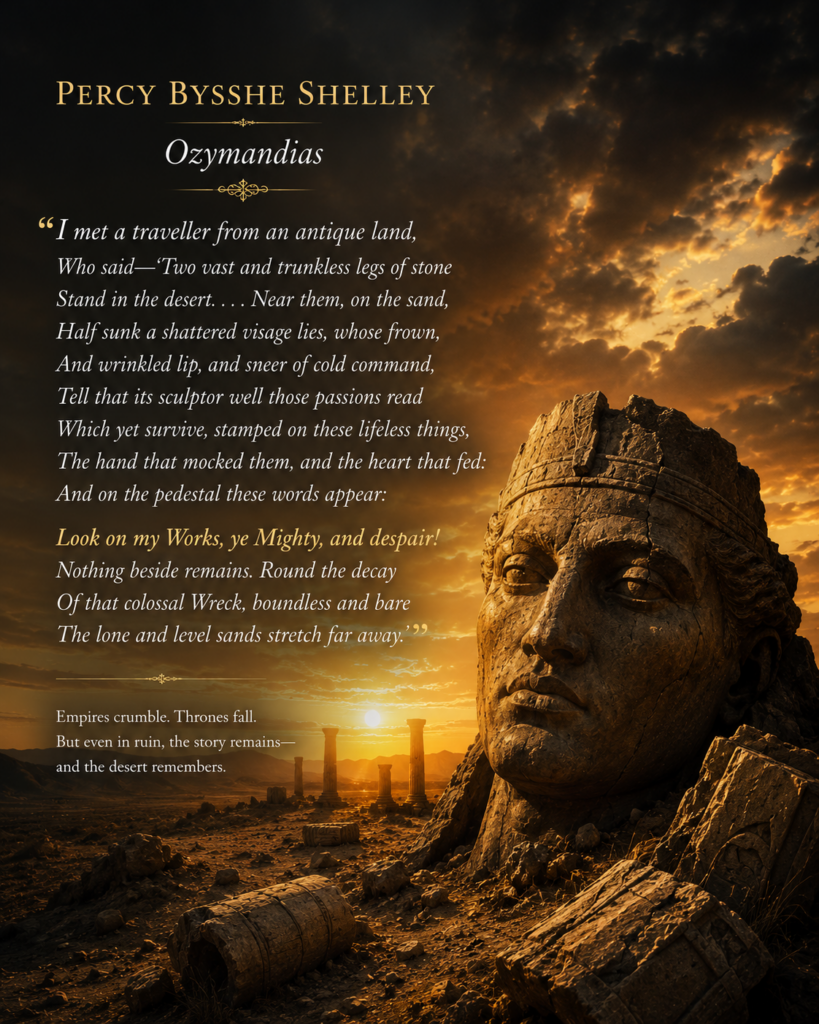
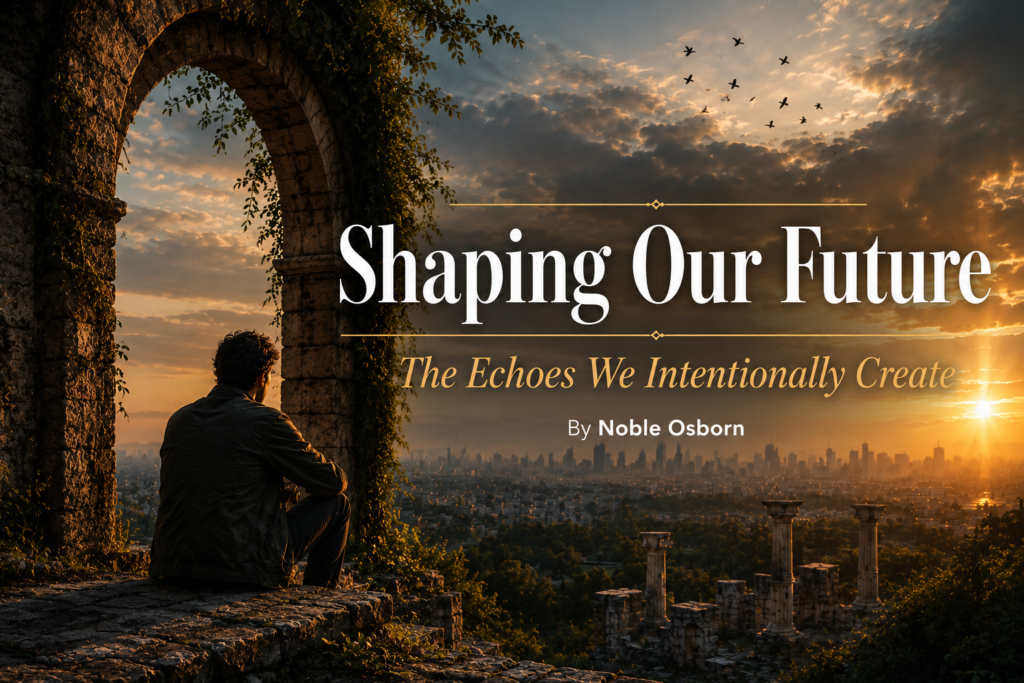
Every generation is born into a conversation it did not begin.
We inherit language before we understand what words can do. We inherit borders before we know who drew them. We inherit songs, monuments, myths, religions, ruins, ceremonies, silences, griefs, loyalties, prejudices, and the thousand unnamed habits of a culture that insists it is natural simply because it arrived before we did.
The past is never as dead as we pretend.
It enters the room before us. It takes its place at the table. It influences which stories are repeated, which portraits remain on the wall, which names are carved into stone, which names are left to weather, and which names are never recorded at all.
We may live in the present, but we do not arrive here empty-handed. We carry the echoes of those who came before us, whether we asked to carry them or not.
This issue has been built around a single question:
What survives us?
At first, the answers seem obvious.
Buildings survive us. Paintings survive us. Poems survive us. Nations survive us. Cathedrals, temples, ruins, letters, photographs, folk songs, archives, family recipes, war memorials, and grave markers all appear to prove that humanity has always been trying to outlast itself.
But survival is more complicated than endurance.
A thing can remain and still be misunderstood. A voice can survive and still be silenced. A monument can stand for centuries and lie the entire time. A painting can hang safely in a museum while the person who made it disappears behind the style, the market, the mythology, or the convenience of forgetting.
A nation can live long after the young have died defending it and still fail to remember them honestly.
What survives us is not only what remains.
It is what is interpreted.
It is what is protected.
It is what is repeated.
It is what future generations are permitted to question.
That is where responsibility begins.
We are not merely the inheritors of echoes. We are also their makers.
Every age likes to imagine itself as temporary. We tell ourselves we are only passing through a difficult season, only responding to emergencies, only doing what circumstances require. We treat the present as a narrow hallway between the grandeur of the past and the uncertainty of the future.
Yet the present is the only place where history is actually made.
It is where neglect becomes policy, where care becomes tradition, where silence becomes erasure, and where courage becomes memory.
The future does not arrive fully formed.
It is assembled from today’s decisions.
It is built from what we fund and what we abandon. It is shaped by whose pain we document and whose pain we dismiss. It is shaped by which artists are given room to work, which books are removed from shelves, which communities are granted dignity, which buildings are restored, which rivers are poisoned, which children are taught the truth, and which truths are considered too inconvenient to survive.
We often speak of legacy as though it belongs only to the powerful.
Presidents have legacies. Kings have legacies. Empires, generals, patrons, billionaires, museums, and institutions have legacies. Their names are attached to wings, laws, wars, foundations, universities, and failures.
But legacy is not the private property of power.
Legacy is the residue of action.
A teacher leaves a legacy in the mind of a student who learns not only the subject, but the shape of curiosity. A gardener leaves a legacy in soil made richer than it was found. A parent leaves a legacy in the emotional weather of a child’s life. An artist leaves a legacy by making visible what others were taught not to see.
A citizen leaves a legacy in the vote cast, the protest joined, the neighbor defended, the lie refused, and the cruelty interrupted.
Most of what matters will never be placed under glass.
Most of what survives us will not bear our names.
That does not make it less real.
We are accustomed to thinking of the future as distant and abstract. It belongs to someone else: the young, the unborn, the imagined generation that will inherit whatever we leave behind.
But the future is not some faraway country.
It is already here, gathering evidence.
It is watching what we normalize. It is listening to what we excuse. It is learning from what we repair and from what we permit to collapse.
The future will know us by our patterns.
It will know whether we mistook speed for progress. It will know whether we confused convenience with wisdom. It will know whether we used beauty as decoration or allowed it to become a form of truth.
It will know whether we defended identity only when doing so was easy, whether we honored history only when it flattered us, whether we protected art only when it was profitable, and whether we treated memory as a living obligation or merely as a storage room.
Every civilization leaves behind two histories: the one it intended and the one it could not hide.
The intended history is carved into monuments. It is printed in official programs. It appears in portraits, speeches, national holidays, museum placards, and ceremonial language. It tells us who a culture wanted to be.
The hidden history lives elsewhere.
It lives in the omissions.
It lives in the laborers unnamed beneath the cathedral. It lives in the women whose work was attributed to men. It lives in queer lives translated into acceptable friendship. It lives in colonized objects displayed as universal treasures. It lives on battlefields where the dead are honored more easily than the reasons they died are examined.
The future inherits both.
And so the question is not whether we will leave echoes.
We will.
The question is whether we will leave echoes of honesty or denial, care or consumption, imagination or fear.
To shape the future is not to control it.
That is the old fantasy of empire: the belief that if enough stone is stacked, enough borders are drawn, and enough names are stamped into bronze, a civilization can command how it will be remembered.
But memory is never obedient for long.
Ruins rebel against their builders. Archives reveal what institutions hoped to bury. Art changes meaning when new eyes arrive before it. The young ask questions the old were trained to avoid.
The future is not a possession.
It is a conversation.
We enter that conversation every day, whether we intend to or not. We enter it when we decide what deserves preservation. We enter it when we decide whose dignity is negotiable. We enter it when we decide whether beauty is a luxury or a necessity.
We enter it when we choose whether to restore what has been broken or simply photograph the ruin and move on.
This is why art matters.
Art is one of the ways humanity leaves messages for people it will never meet.
A painting says: This is what we saw.
A poem says: This is what we felt.
A building says: This is what we believed deserved permanence.
A song says: This grief had rhythm. This joy had breath. This body existed. This love was real.
Art does not stop time.
It gives time something to carry.
Identity matters for the same reason.
To name oneself honestly in a hostile age is to leave evidence. To love openly when history prefers erasure is to create an echo stronger than silence. To insist upon complexity when culture demands simplicity is to make the future more difficult to deceive.
Memory matters because, without it, power gets to begin every story at the most convenient chapter.
Culture matters because it is the atmosphere in which tomorrow learns how to breathe.
That is the work before us.
Not to become permanent. Nothing human is permanent.
Not to defeat time. Time is not an enemy to be conquered.
The work is to become worthy of being remembered truthfully.
There is humility in that.
Perhaps the best legacy is not a monument to ourselves, but a world made less afraid of honesty because we lived in it. Perhaps the echoes we should want to leave are not declarations of our greatness, but evidence of our care.
A restored voice.
A protected place.
A child taught to ask better questions.
A community allowed to survive.
A work of art rescued from oblivion.
A silence broken before it hardened into history.
We do not choose the world we inherit.
We do choose what we amplify.
We choose whether old prejudices pass through us unchanged or end with us. We choose whether inherited beauty is preserved, neglected, sold, or shared. We choose whether the stories that shaped us become cages or doorways. We choose whether the past remains a weapon or becomes a teacher.
The world is on edge because too many people have mistaken destruction for renewal. Too many have confused forgetting with freedom. Too many have decided that the easiest way to shape the future is to narrow who gets to belong in it.
But the future is not made only by those who shout the loudest.
It is also made by those who keep the archive, restore the mural, write the poem, protect the river, open the gallery, teach the forbidden book, defend the vulnerable neighbor, and refuse to let cruelty become ordinary.
History may turn on spectacular events, but legacy is usually built through quieter repetitions.
What we practice becomes what survives.
That may be the most difficult truth of all.
We cannot claim to value beauty while making peace with ugliness. We cannot claim to honor memory while participating in erasure. We cannot claim to love the future while consuming everything it will need. We cannot claim to respect identity while demanding that people become smaller in order to be safe.
The echoes we leave are not created by what we say we believe.
They are created by what we make real.
So what survives us?
Perhaps not the version of ourselves we would most like preserved. Perhaps not the polished image, the careful statement, the flattering portrait, or the name engraved above the entrance.
What survives us may be the consequence.
The changed law.
The saved building.
The restored painting.
The protected child.
The recovered name.
The widened doorway.
The truth finally spoken aloud.
The future will not ask whether we lived in easy times. No generation does. Every age inherits some combination of fracture, danger, beauty, and responsibility.
The future will ask what we did with the time that was ours.
Did we merely echo what came before us?
Or did we change the sound?
That is the invitation at the end of this issue.
Not simply to admire what endured. Not simply to mourn what was lost. Not simply to study ruins, artists, soldiers, buildings, poems, and forgotten voices as though they belonged to some sealed chamber called the past.
The invitation is to understand ourselves as participants in the same conversation.
We are already becoming someone else’s inheritance.
Long after we are gone, something of us will remain.
Not everything. Not enough to satisfy the ego. Not always in the form we intended.
But something.
A mark.
A memory.
A wound.
A shelter.
A warning.
A song.
The task is not to live forever.
The task is to leave behind something that helps the living continue.
That is how the future is shaped.
Not by escaping time, but by giving it something worth carrying.